


Fundamentals of NRI Banking: Everything You Need to Know

The common advice about NRI banking goes something like this: just open an NRE account and forget about it.
For years, that was considered sufficient.
Today, that advice is not just incomplete - it's potentially costing you money in unnecessary taxes and missed opportunities.
Managing finances across two countries feels a bit like juggling while riding a bicycle. Everything needs to stay in motion, and dropping one ball can throw off everything else. The fundamentals of NRI banking aren't complicated once you understand the logic behind each account type, but getting them wrong can lead to frozen funds, surprise tax bills, and bureaucratic headaches that take months to untangle.
So let’s start with the basics.
What is an NRI Account
Technically, there isn’t one single account that can be called an ‘NRI Account’. There are a bunch of accounts that essentially act as specialised bank accounts designed for Indian citizens living abroad or persons of Indian origin residing outside India. Think of them as a financial bridge connecting your overseas earnings with your roots back home. These accounts operate under specific Reserve Bank of India (RBI) and Foreign Exchange Management Act (FEMA) guidelines, which dictate everything from deposit limits to repatriation rules.
The critical distinction here? Not all NRI accounts serve the same purpose. Some are built for foreign income. Others handle Indian earnings. Mixing them up is where most people run into trouble. Let’s look at each of them in detail.
Types of NRI Bank Accounts and Their Key Features
1. NRE (Non-Resident External) Account
The NRE account is your go-to for parking foreign earnings in India. Here's what makes it attractive:
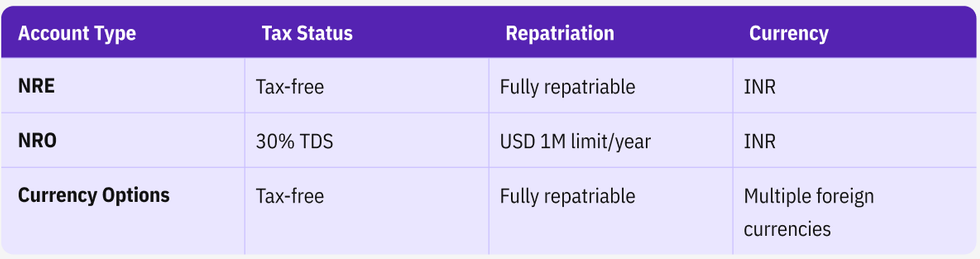
- The funds and interest earned remain completely exempt from Indian taxation. That's a significant NRE account benefit that most overseas Indians undervalue.
- NRE accounts exclusively cater to funds from abroad, allowing complete repatriation of both principal and interest.
- This means your hard-earned money overseas stays protected from Indian tax obligations. Full repatriation. No limits. No complications.
But here's the catch many people miss - you cannot deposit Indian-sourced income into an NRE account. Rental income from that flat in Mumbai? That needs to go elsewhere.
2. NRO (Non-Resident Ordinary) Account Essentials
This is where your Indian income belongs.
- Rent, dividends, pension payments - all of it flows into an NRO account. The trade-off for this flexibility is NRO account taxation at source.
- Interest earned on NRO accounts attracts TDS at a flat rate of 30%, making it liable for Indian taxation.
- You can jointly hold this account with a local Indian resident, which helps if you have family managing properties on your behalf.
- Repatriation from NRO accounts is capped at USD 1 million per financial year. That sounds generous, but it requires proper documentation and tax compliance. Skip the paperwork, and your transfer gets stuck.
3. FCNR (Foreign Currency Non-Resident) Account Benefits
What if you want to avoid currency fluctuation risk entirely?
- The FCNR account holds your deposits in foreign currencies - USD, GBP, Euro, and more.
- The interest earned remains tax-free in India, and both principal and interest are fully repatriable.
- The tenure ranges from 1 to 5 years, functioning essentially as a term deposit. Interest rates tend to be lower compared to NRE and NRO accounts. But the currency protection is the real draw here.
Opening NRI Bank Accounts: Complete Process and Documentation
Essential Documents Required for Account Opening
Knowing how to open an NRI bank account starts with getting your paperwork sorted. The essentials include:
- Valid passport and visa (or OCI/PIO card)
- Overseas address proof - utility bills or bank statements work
- PAN card or Form 60 (if no taxable income in India)
- Recent passport-sized photographs
- Employment verification documents
Here's where it gets frustrating.
Different banks have different attestation requirements. Self-attestation works if you're applying in person, but remote applications often need embassy verification. The single most frustrating part of this process is discovering your documents don't meet a specific bank's format requirements after you've already submitted everything.
Step-by-Step Account Opening Procedures
The process itself is straightforward on paper. Fill out the application form, upload documents, complete verification. Some banks require a video call, others want an in-person meeting at a designated branch. It sounds simple, right?
In practice, verification can take anywhere from three days to three weeks depending on document completeness and bank efficiency. Keep copies of everything. Follow up persistently.
Digital Account Opening: The Dream vs Today’s Reality
The dream of NRI banking is simple: a completely digital account opening experience. No couriering documents across countries. No embassy visits. No weeks of waiting just to hear that one form needs to be re-submitted.
That dream is partially alive today, but the reality still falls short.
While many banks advertise “digital” NRI account opening, the process often breaks down at the most critical steps. Notarisation, physical attestation, and extended KYC checks can stretch timelines from days into weeks. What looks seamless on a website frequently turns into email chains, manual follow-ups, and compliance bottlenecks that are anything but digital.
Branch-based account opening is even more cumbersome. It requires in-person visits, physical paperwork, and coordination across time zones, a near-impossible task for NRIs managing life abroad.
This gap between promise and reality is exactly what needs to change.
At Aspora, we’re building toward true digital NRI banking, starting with fully digital NRE and NRO account opening, designed for NRIs from the ground up. No redundant paperwork. No unnecessary delays. No dependence on physical branches.
Critical Rules and Requirements
Repatriation Rules and Annual Limits
Understanding NRI account repatriation rules saves headaches later. NRE and FCNR accounts allow full repatriation without limits - your foreign money comes and goes freely.
NRO accounts require more planning. You'll need Form 15CA and Form 15CB for tax compliance before repatriating. Tax liabilities including income tax and capital gains must be resolved beforehand. Fail to file these forms correctly, and your transfer gets blocked.
Taxation Framework for Different Account Types
The tax picture is actually quite simple once you understand the pattern:
- NRE accounts: Interest completely tax-exempt in India
- NRO accounts: Interest taxable at flat 30% rate
- FCNR accounts: Interest tax-free in India
Honestly, the only thing that really matters here is routing your funds correctly from the start. Get your foreign income into NRE/FCNR accounts. Keep Indian income in NRO accounts. Don't mix them.
Account Conversion Guidelines When Status Changes
Returning to India permanently? This is critical. You must convert NRE and NRO accounts to regular savings accounts. Failing to do so violates RBI regulations and can result in account freezes and penalties.
The timeline matters. Notify your bank immediately upon return and complete conversion within 2-3 months of your status change. Keep foreign currency in RFC (Resident Foreign Currency) accounts to avoid immediate conversion losses. Update all linked services - demat accounts, insurance policies, everything.
So, Which Accounts Should You Open as an NRI?
Most people tend to spend their time comparing interest rates when what they should really focus on is tax efficiency and repatriation flexibility first. Interest rates matter, but paying 30% tax on NRO interest versus zero on NRE interest makes a far bigger difference to your bottom line.
Start with your primary need. Parking overseas earnings? Go NRE. Managing Indian income? Open NRO. Concerned about rupee depreciation? FCNR deserves consideration. Many NRIs maintain all three for different purposes - that's perfectly sensible.
Frequently Asked Questions
Can I open a joint NRE account with my resident Indian spouse?
No. NRE accounts can only be held jointly with another NRI or PIO. Your resident spouse can be a mandate holder with limited operational rights, but not a joint account holder.
What happens to my resident savings account when I become an NRI?
You must redesignate it as an NRO account or close it entirely. Continuing to operate a resident account as an NRI violates FEMA regulations.
Is PAN card mandatory for opening all types of NRI accounts?
Not always. You can submit Form 60 if you have no taxable income in India. However, having a PAN card simplifies tax compliance and is strongly recommended.
How much money can I repatriate from my NRO account annually?
Up to USD 1 million per financial year, covering both principal and interest. This requires proper documentation and tax compliance certificates.
Which NRI account type offers the best tax benefits?
NRE and FCNR accounts offer complete tax exemption on interest earned in India. NRO accounts attract 30% TDS on interest. For pure tax efficiency, NRE wins - provided your funds originate from overseas.
Download the app