


India Budget 2026: Key Changes for UAE NRIs

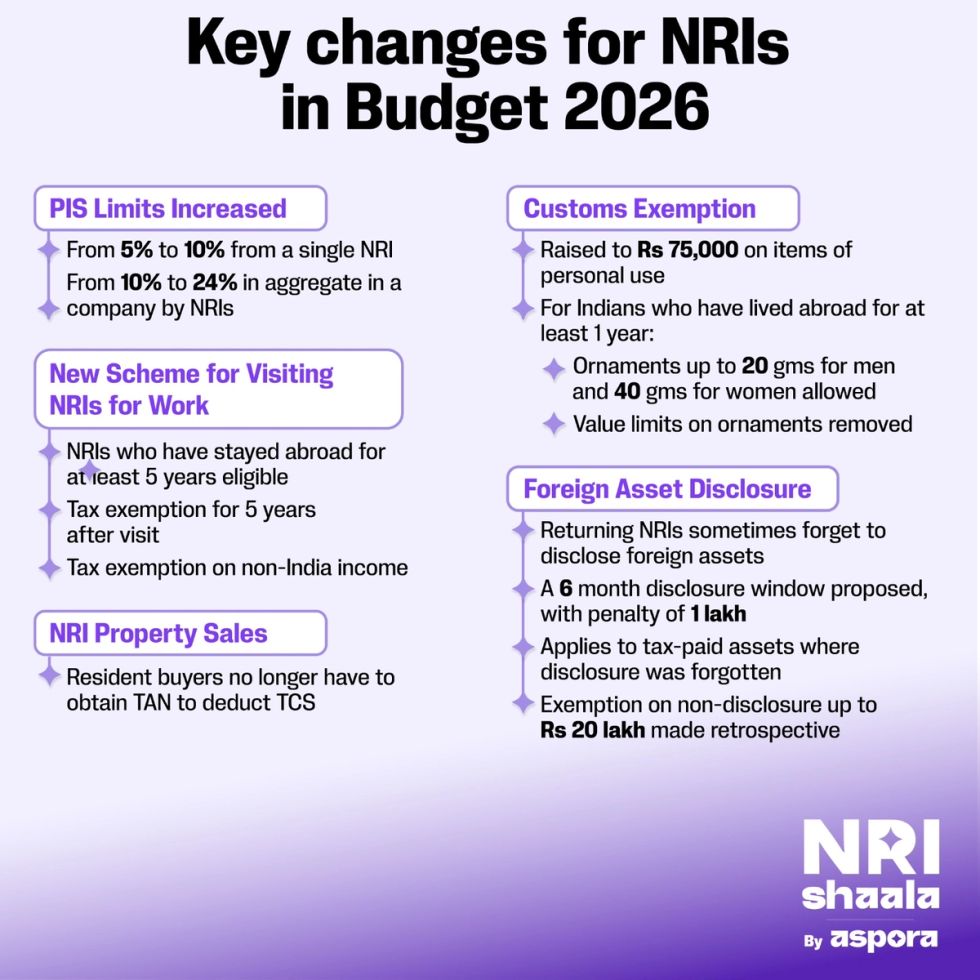
The Government has made some important ease of living reforms in Budget 2026 that affect UAE NRIs. From increased ownership limits in Indian companies to easier compliance for NRI property sales, Budget 2026 has it all.
1. Higher PIS Limit
Finance Minister Nirmala Sitharaman raised the limit on ownership of a single company by a person resident outside India from 5% to 10%. She also raised the limit for overall ownership in a company by such persons from 10% to 24%. This will allow UAE NRIs to invest greater amounts of money into Indian companies.
2. Tax-free Foreign Income of NRIs Rendering Service in India
The finance minister has also introduced a scheme to allow NRIs visiting India to render certain defined services and get exemption on their foreign income. This exemption will apply for a period of 5 years from the start of rendering the service. The NRI must have lived abroad for the preceding 5 years for this exemption to apply. This has been done to attract talented professionals of Indian origin to India. The details of which services qualify for this exemption will be released later.
3. Easier Compliance for NRI Property Sales
A resident buying property from an NRI has to deduct TDS. However the government has allowed resident deductors to use their PAN number for this TDS rather than obtaining a TAN number. This could make the process of selling property easier.
4. Higher Customs Limits
Budget 2026 has raised the limit for customs free items of personal use to Rs 75,000. This applies to Indian residents as well as NRIs. It has also allowed Indians who have been abroad for more than a year to carry back jewellery up to 20 grams for men and 40 grams for women. Earlier there were value caps of Rs 1 lakh for women and 50,000 for men apart from weight caps and this created ambiguity.
5. Foreign Asset Disclosure
Returning NRIs will also benefit from the relaxations given on the disclosure of foreign assets. Many NRIs forget to disclose their bank accounts and other assets acquired abroad even after their status changes back to resident. This leads to the possibility of penalty and prosecution. The finance minister proposed a 6 month window during which individuals who have failed to disclose income which has come from already taxed sources will only pay a fine of Rs 1 lakh. There will be no further penalties and prosecution.
Conclusion
Budget 2026 signals a clear shift in how India views its diaspora—not just as a source of remittances, but as investors, professionals, and active participants in India's growth story. The higher PIS limits open doors for serious equity investments, while the tax exemption for NRI professionals could bring valuable expertise back home. The compliance simplifications, though seemingly small, remove real friction points that have frustrated NRIs for years. If you've been sitting on the fence about investing more in India or considering a temporary return, these changes make both options more attractive. As always, consult your tax advisor to understand how these provisions apply to your specific situation.
Most Asked Questions About Key Changes for UAE NRIs in India's Budget 2026
What is the PIS limit and how does the increase help me?
The Portfolio Investment Scheme (PIS) allows NRIs to buy shares in Indian companies. Previously, a single NRI could own only 5% of a company's shares, and all NRIs combined couldn't own more than 10%. Budget 2026 doubled these limits to 10% and 24% respectively, allowing you to invest larger amounts in Indian equities.
Can I invest more than 10% in any Indian company now?
As an individual NRI, you can now hold up to 10% of a single company's shares (up from 5%). However, the total NRI ownership in that company cannot exceed 24%. Check the company's existing NRI shareholding before making large investments.
What is the tax exemption for NRIs rendering services in India?
NRIs who return to India to provide certain specified services can get a 5-year exemption on their foreign income. You must have lived abroad for at least 5 years before returning. The government will announce which professional services qualify for this exemption later.
Does the tax exemption apply to all types of foreign income?
Details are awaited, but the exemption appears targeted at professional service income for skilled individuals. It likely won't cover passive foreign income like dividends or rental income. Wait for the detailed notification before planning your return.
What's changed about TDS on NRI property sales?
Previously, buyers had to obtain a separate TAN (Tax Deduction Account Number) to deduct TDS when purchasing property from an NRI. Now they can use their existing PAN number, simplifying the process and potentially speeding up property transactions.
How much can I bring back from Dubai without paying customs now?
The duty-free allowance for personal items has increased to Rs 75,000 (from Rs 50,000). Additionally, you can bring gold jewelry—up to 20 grams for men and 40 grams for women—if you've been abroad for over a year, with no value cap confusion.
What happened to the old jewelry value limits of Rs 50,000 and Rs 1 lakh?
Budget 2026 removed those value caps entirely. Now it's purely weight-based: 20 grams for men, 40 grams for women, if you've been abroad for more than a year. This eliminates the previous ambiguity about valuation.
What is the foreign asset disclosure window?
If you've returned to India and became a resident but forgot to disclose your foreign bank accounts or assets in your tax returns, you now have a 6-month window to declare them. You'll only pay a Rs 1 lakh fine with no criminal prosecution, provided the income was already taxed abroad.
Who should use the foreign asset disclosure scheme?
This is for returning NRIs who forgot to disclose their Dubai bank accounts, overseas properties, or other foreign assets after becoming Indian residents. It's not for undeclared income or tax evasion—only for disclosure lapses on already-taxed income.
Should I move money to India to take advantage of the higher PIS limit?
The higher limit creates opportunity but shouldn't drive your decision alone. Consider factors like rupee depreciation risk, company fundamentals, your overall asset allocation, and whether you need that liquidity. The PIS increase removes a barrier, but good investment judgment still applies.
Download the app