


Welcome Home: A Guide to Your Next India Visit

If your last visit to India was more than a couple of years ago, this is a guide that navigates recent regulatory, documentation and digital shifts in India. This ensures your trip is defined by family and food, not mental maths and figuring out basics from scratch.
Safe travels and enjoy the chai! ☕
Before Anything Else - Who Are You, Exactly?
"NRI" is a word that gets used loosely - and what you need to do before this trip depends entirely on which category you actually fall into.
For your quick reference: Ten seconds here saves a lot of airport anxiety later. Navigate across 3 tabs.
☑️ NRI
Indian passport holder living abroad 182+ days/year. You're still an Indian citizen. Enter on your Indian passport. No visa, no e-Arrival Card. Just make sure your passport has 6+ months validity.
☑️ OCI
Took foreign citizenship, still of Indian origin. Travel on foreign passport + OCI card. Visa-free entry for life. Since Oct 4, 2025: you also need to fill out the e-Arrival Card.
⚠️ PIO
PIO cards expired December 31, 2025. India will not permit entry on a PIO card after that date. You need to either convert to OCI or travel on a regular visa. Do not ignore this.
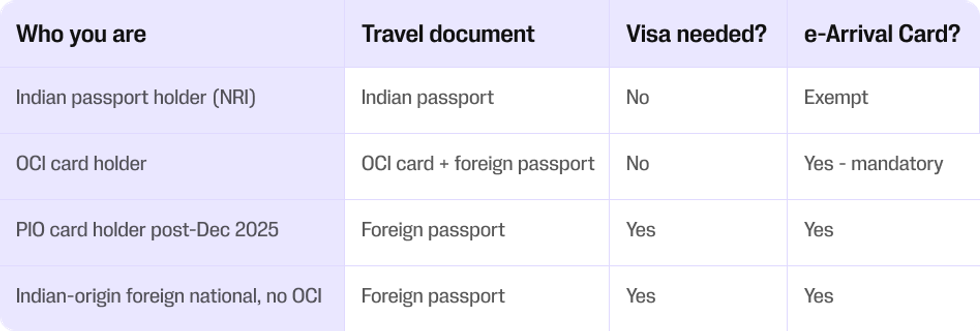

Get this right before you even think about packing. India loves paperwork almost as much as it loves chai. Here's what you actually need.
1. The e-Arrival Card if You’re Arriving on a Foreign Passport
As of April 1, 2026, paper forms are fully retired - airlines now face ₹50,000 fines per non-compliant passenger, a policy change formally documented in KPMG's GMS Flash Alert 2025-206. Don't be the reason your flight gets delayed. Indian passport holders are exempt.
Fill it out at indianvisaonline.gov.in/earrival within 72 hours of arrival. Five minutes, generates a QR code, immigration scans it when you land. As of April 1, 2026, paper forms are fully retired - airlines face ₹50,000 fines per non-compliant passenger. Don't be the reason your flight gets delayed.
👉 Did You Know? The old paper Disembarkation Card you'd fill out mid-flight? Entirely gone. Airlines are now liable for passengers who arrive without the e-Arrival Card, which is why you may get asked at check-in.
2. Your OCI Card if You’re an OCI Holder
Your OCI card doesn't expire. You don't need a new one every time you renew your passport - except once, if you got your OCI card before age 20 (reissue it after your 20th birthday so the photo matches your face).
When you renew your passport, upload the new one to the OCI portal within 3 months. No new physical card - just an updated link in the system.
👉 Rule change most people still don't know about You no longer need to carry your old, expired passport when travelling to India. For years, the requirement was to bring every passport your OCI had ever been linked to. That rule is now gone.
3. Travel Insurance
A significant number of global health insurance plans exclude your "country of origin" - meaning India might not be covered. Check yours before you fly.
India's private hospitals are genuinely world-class now, but also priced accordingly. A three-day stay at a good Apollo or Fortis facility can run into the lakhs. A dedicated NRI travel health plan for a 30-day visit runs ₹3,000-8,000 (from ₹22/day with ICICI Lombard). Check for providers that also offer NRI special plans.
A few options worth exploring:
ICICI Lombard
NRI-specific travel health plans starting from ₹22/day for a 30-day visit. One of the most widely used options for the diaspora.
Care Health Insurance
Offers a 15% NRI discount and recorded a 96.74% claim settlement ratio in FY2024-25. Worth a look if you travel to India more than once a year.
Tata AIG
International travel plans that explicitly cover India as a destination, not an exclusion. Confirm the "country of origin" clause before purchasing.
Ditto Insurance
Not an insurer but an advisor. Ditto will compare options across providers and tell you plainly what's covered and what isn't. Useful if you've been burned by fine print before.
4. PAN Card
Planning to access Indian bank accounts, move investments, or deal with property? Know your PAN number. If you've lost the card, the NSDL portal (onlineservices.nsdl.com) can reissue it.
👉 NRIs are not required to link PAN with Aadhaar - that's a resident Indian obligation. But if you have both and don't link them, expect KYC friction at banks. 👉 Keep DigiLocker on your phone - it stores verified copies of your Indian documents (Aadhaar, PAN, driving license) and is occasionally requested at hotels, government offices, or during KYC.
This video covers the full paperwork checklist, what's changed in 2026, and how to avoid the most common mistakes at immigration:

The first 45 minutes in India will set the tone for the whole trip. Here's how to make them smooth.
A. Before You Land
Have these ready on your phone before landing, and preferably not while standing at immigration:
- Your passport
- e-Arrival Card QR code (for OCI/foreign passport holders) & your OCI card photo or scan
- Uber/Ola app downloaded and logged in
- Your hotel or home address saved offline - airport WiFi is sometimes unreliable
B. At Immigration - Which Queue, and What to Expect
- Indian passport holders go to the Indian citizen queue. Nothing else needed.
- OCI holders and visa holders go to the foreign nationals queue. Not a separate OCI queue - foreign nationals. Have your e-Arrival Card QR code ready on your phone; immigration scans it before stamping your passport.
Immigration queues at major airports (Delhi, Mumbai, Bangalore) can run 30-60 minutes during peak international arrival windows - typically 2am–6am and 10pm-midnight. If your flight lands during these windows, it’s best to budget the time.
Quick note on priority lanes:
- Business/First Class passengers get priority immigration lanes at all major international airports (Delhi, Mumbai, Bangalore, Hyderabad, Chennai). If you're flying up front, look for the "Priority" or "Premium" signs right after you deplane.
- Senior citizens (60+) have dedicated lanes at most major airports, separate from both the Indian citizen and foreign nationals queues. Really useful if you're travelling with parents.
- There's no dedicated NRI-only fast track, which might be frustrating. OCI holders land in the foreign nationals queue regardless of how often they travel.
C. Customs & What You Can Bring In
For adults travelling from most countries, the duty-free allowance is ₹50,000 worth of goods (approximately £470 / $600 / AED 2,200). Beyond that, customs duty applies.
What this means practically:
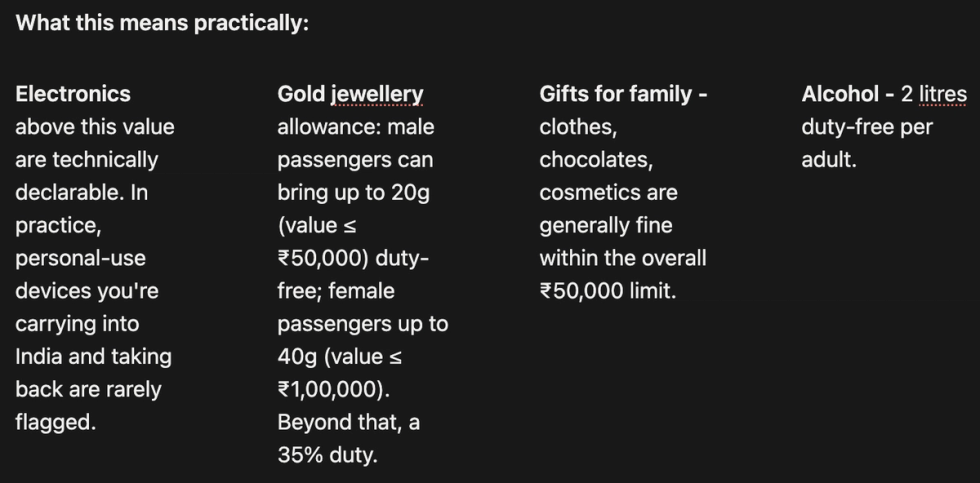
👉 The practical reality: Most NRIs arriving with personal luggage and family gifts sail through green channel without issue. The red channel is for declarable goods. When in doubt, use red - the fine for non-declaration is significantly worse than the duty itself. 👉 There’s an app called DigiYatra. You can use it for your return journey, not arrival. It's a biometric boarding system for departures at 12 major airports - face scan instead of boarding pass at security. Register before your return flight at digiyatrafoundation.com.
D. Latest Updates on Major Airport Terminals
- Mumbai now has two international airports. Navi Mumbai International Airport (NMIA) opened December 25, 2025. When booking flights into Mumbai, check whether you're landing at BOM (Chhatrapati Shivaji Maharaj, T2) or NMIA - they are ~40km apart.
- Delhi has domestic flights split across T1, T2, and T3 depending on airline. T3 handles all international arrivals.
- Bangalore - now all international flights use Terminal 2. Domestic uses Terminal 1.
- Ahmedabad - Air India moved all domestic operations in Ahmedabad from T1 to T2 effective March 29, 2026. T2 is now handling both international and Air India domestic flights. If you're connecting domestically through Ahmedabad, confirm your terminal at booking - other domestic airlines may still use T1.
- Chennai - The Phase 1 terminal (opened in April 2023) handles international arrivals. A new car park tunnel from arrivals became operational February 2026.
- Hyderabad - No recent terminal-related changes.
- Kochi - No recent terminal-related changes.

Cash is no longer king in India. UPI is, and it's delightfully democratic - the same system used by India's largest companies also powers the chai stall on the corner.
1. UPI
You can spend 10 days in any major Indian city without touching cash. This is not an exaggeration. The same country that had 86% of its currency wiped out overnight in November 2016 now processes 49% of all global real-time payments. The IMF has officially declared UPI the world's largest retail payment system by volume - not just for emerging markets. Globally.
And that’s exactly why it’s important you set it up on priority when you visit India.
👉 For NRIs and OCI holders specifically: you can now activate UPI using your international mobile number - no Indian SIM required.
For UPI, either Google Pay or PhonePe will do the job once linked to your NRE/NRO account on your international number - they're interchangeable and universally accepted. Pick one, set it up before/after you fly, and you're covered for virtually everything.
Paytm is worth having as a backup; it's still widely used for utility payments, older merchants, and some ticketing platforms that haven't fully moved to standard UPI.
How to activate UPI before your flight:
- Log into your NRE/NRO bank account via net banking - confirm your international number is the primary contact
- Download Google Pay, PhonePe, or BHIM
- Register using your number with country code: +44 UK · +1 US · +971 UAE
- The app detects your linked bank account and prompts you to set a UPI PIN (To check supported banks and countries view: npci.org.in/product/upi-global-acceptance/upi-for-nris)
👉 Important to know: For OTP verification to work in India, your international number must be active and receiving SMS throughout your trip. Don't let your plan lapse before flying, and don't port your number the week before you leave. WhatsApp Pay does not support NRI international numbers. It's domestic transfers only. Stick to Google Pay, PhonePe, or BHIM.
2. Cash, ATMs & Getting the Best Rate
- Cash Cash is increasingly optional in cities but still expected in remote areas and some auto-rickshaws. Carry some - just not as much as you used to. ₹5,000–10,000 in your wallet is usually enough to get through most situations without touching UPI.
- ATMs Indian ATMs are still widely available in cities, airports, and most towns, but there are a few things worth knowing before you walk up to one with a foreign card. Most ATMs cap foreign card withdrawals at ₹10,000 per transaction - that's roughly £90–95, $110–120, or AED 400, depending on where you're from. If you need more, you'll need to do multiple withdrawals - sometimes at different machines, as some banks also set a daily limit per foreign card. Not all ATM networks in India process foreign cards equally. HDFC, ICICI, Axis, and SBI ATMs are the most reliable for international cards - fewer declines, better connectivity. Smaller co-operative bank ATMs can be hit or miss. If a machine declines your card with no clear reason, try a different bank's ATM before assuming your card is the issue.
👉 One trap to watch: Many ATMs in India offer Dynamic Currency Conversion (DCC) - a prompt asking if you'd like to be charged in your home currency instead of INR. It sounds convenient. It isn't. The ATM's conversion rate is typically 3-5% worse than your card's rate, and that's before any fees. Always choose INR. Always. Let your own bank handle the conversion.
- Getting the Best Exchange Rate There are broadly three ways to access money in India as an NRI, and the rate you get varies significantly depending on which route you use. Option 1 - Transfer to your NRE/NRO account from your bank account A common way is to transfer money from your foreign bank account before or during your trip to your Indian bank account, and then use Indian ATMs or UPI directly. Example, moving money from your Lloyds account in UK to your SBI account in India. Option 2 - Use a new-age money transfer app Apps like Wise, Remitly, Aspora and Western Union have made international money transfer significantly cheaper than the traditional bank wire route. You can send money to any Indian bank account, including your own NRE/NRO account or a family member's account, and the recipient can withdraw cash from any ATM or spend via UPI. Option 3 - Airport forex counters Available at every major Indian airport, open around the clock, and genuinely convenient if you've landed with nothing. The trade-off: airport forex counters typically charge 10-12% above mid-market rates, and they know you're captive.

Getting around India is cheaper, faster, and more connected than it's ever been. The key is knowing what to use and when.
Uber and Ola are your default - your existing account works, they are reliable for airport pickups, and behave exactly as you'd expect. The real discovery for most returning NRIs could be Rapido - bike taxis, autos, and cabs now operating in 500+ cities.
Shoffr - A newer name in the market but one worth bookmarking. For airport transfers and longer runs, it's advance-booking only, the cars are genuinely good, and the experience is the closest India gets to a black car service.
Namma Yatri - If you're in Bangalore, Chennai, Kolkata, Kochi, Delhi, or Hyderabad, this one's worth having. It's an open-network ride app that connects you directly to drivers - no middleman, no surge logic. It enlists autos and cabs, depending on the city.
RailOne - For trains within India this is the one app you need: launched July 2025 by Indian Railways to replace the old IRCTC Rail Connect, it handles ticket booking, live tracking, PNR status, and onboard food ordering in one place.
Google Maps is finally more reliable across India, traffic data is accurate, walking routes work, and it's a genuine transformation from five years ago.

Your quick guide to staying connected without the frustration.
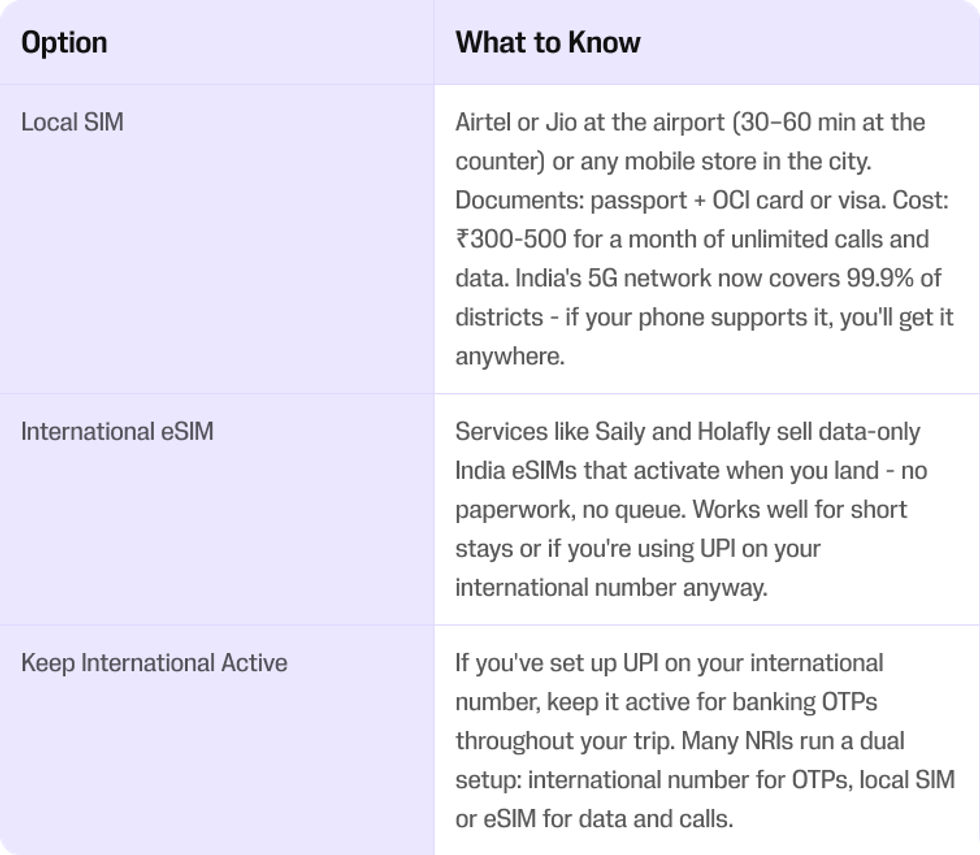
👉 One thing to watch at airport SIM counters Some airport vendors have been asking for a "local contact" as part of KYC - which can occasionally become an excuse to overcharge. Insist on the standard process, or pick up your SIM in the city instead.

The biryani has been living rent-free in your head since the moment you booked your flight.
Zomato and Swiggy are the default interface for restaurant discovery - it's where you figure out where and what to eat in an unfamiliar neighbourhood.
The real eating in India - the stuff that hits differently after years abroad is still the local joints. The Mumbai vada pav at 11pm. The Kolkata kathi roll in the rain. The Chennai filter coffee at 7am. The melt-in-mouth Lucknow galouti kebabs. None of this shows up in a Michelin guide and all of it is irreplaceable.
Here is Zomato's curated top lists of restaurants before you plan your trip so you can make your own checklist:
Mumbai ▪︎ Delhi ▪︎ Bangalore ▪︎ Chennai ▪︎ Hyderabad ▪︎ Kolkata ▪︎ Ahmedabad
The Michelin Guide also arrived in India in 2023 - and the restaurants it recognised weren't surprises to anyone who'd been paying attention. For the full Michelin India list checkout: guide.michelin.com/in/en
For everything else - groceries, toiletries, medicine, snacks, a phone charger at midnight - Blinkit, Swiggy Instamart, Zepto, and BigBasket have built a quick commerce infrastructure that doesn't exist at this scale anywhere else in the world. If you haven't been back in a few years, this will genuinely surprise you. Order something just to experience it - it’s worth the shocker.
🤍 BONUS: Your Homecoming Playlists
While you're packing or obsessively re-reading the paperwork at 1am, or already staring out of a plane window thinking about the biryani that awaits you - here's something to make it feel a little more like homecoming.
Well, that’s about it. The guide ends here. Your trip doesn't.
Coming back to India as an NRI is a strange, wonderful thing. You're not quite a tourist, you know too much. You're not quite a local, you've been away too long. You exist somewhere in between, and honestly, that's the best place to be.
Have a great trip home! 💙
Download the app