

A Smarter Savings Plan for UAE NRIs

The Tax-Free Paycheck Era
Every month you get a tax-free paycheck. These are your prime earning years. UAE is expensive but you’re still able to save a good chunk of your money, to send to India. You steadily build up a corpus to buy your dream home or plan your retirement in a hill-station. Wait, scratch that. This was the old model of saving.
2025's Wake-Up Call: The Rupee Reality
If there’s one thing that 2025 has taught us, putting all your money in the Indian basket is a bad idea. The rupee depreciates against the USD (and linked currencies like the AED). Your hard earned savings are losing value, steadily. No real estate in India is not the answer. It is opaque, hard to manage and illiquid. SIPs? The Indian market does well in some years and fails in others (like 2025). So what then?
Thinking Like a Global Investor
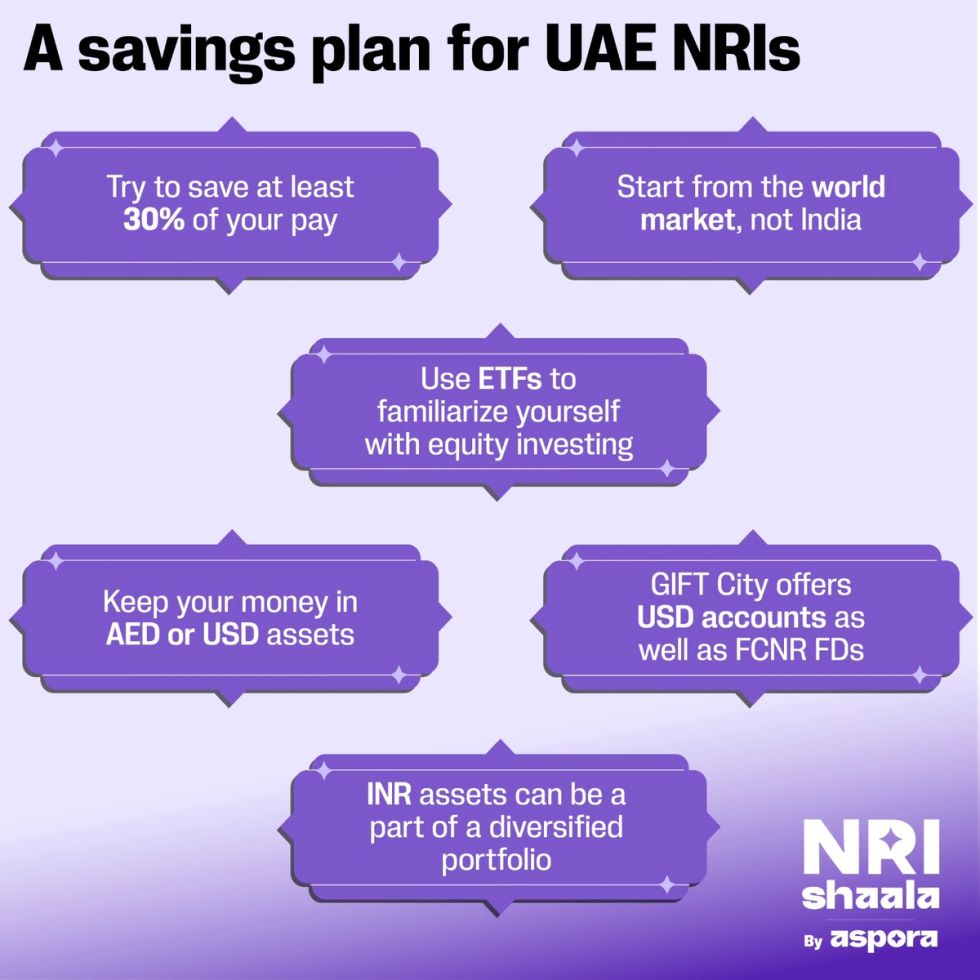
- Your savings plan must begin from neutral gear. You’re a global investor and your allocation must be global.
- Consider an ETF or index fund tied to the world index (MSCI ACWI). Overweight the themes or countries you like and underweight the ones you don’t.
- If you’re worried about AI for example, you might prefer US small caps or emerging market ETFs over US tech. India can be a part of it, but not more than 50%.
- Don’t mix up patriotism or nostalgia for hard investing sense. Relatives, bank relationship managers and other assorted distributors will tug on those strings. Don’t fall for it - you are answerable only to your future self. Sometimes that means building a dollar corpus in GIFT city instead (which is tax-free), sometimes it means keeping your money in AED in UAE.
Opening Your Gateway
But how do you invest globally? Many US brokers are available in the UAE. You can directly open an account with them. They will need details like address proof and tax identification number. Get those local documents in place before you invest. The US does have an estate tax on non-US residents with assets in the US > $60,000. But there’s a solution. Many large brokers also give you access to UCITS Funds and ETFs. These are domiciled in Europe and can invest in the US and elsewhere without estate tax risk. Above all, read extensively and do your own research. Ultimately you are responsible only to your future self.
Conclusion
Your earning years in the UAE are limited and precious. Don't waste them by defaulting to what everyone else does or what your parents did. The world has changed - the rupee isn't stable, Indian real estate is a headache, and you have access to investment options your parents never did. Build a portfolio that matches your global life, not just your nostalgia. Diversify across geographies, keep some savings in dollars or dirhams, and resist the pressure from relatives and relationship managers pushing India-only products. Your future self - whether retiring in Goa or staying in Dubai - will thank you for thinking clearly today. Start small if you must, but start global.
Most Asked Questions About a Savings Plan for UAE NRIs
Why shouldn't I invest all my savings in India?
The rupee depreciates 3-4% annually against the dollar and dirham, eroding your AED purchasing power. Indian markets are volatile, real estate is illiquid and hard to manage from abroad, and you're concentrating risk in a single economy. Diversification protects you.
2. What is MSCI ACWI and why should I consider it?
MSCI ACWI (All Country World Index) is a global index covering stocks from 47 countries—both developed and emerging markets. Investing in an ACWI ETF gives you instant global diversification without picking individual countries or stocks.
3. Can I still invest some money in India?
Absolutely. Keep India as part of your portfolio—up to 50% if you're returning home eventually. But balance it with global investments so rupee depreciation and India-specific risks don't wipe out your savings.
4. How do I open a US brokerage account from the UAE?
Major US brokers like Interactive Brokers and Charles Schwab accept UAE residents. You'll need your Emirates ID, proof of address (utility bill or tenancy contract), and a UAE tax identification number. Some brokers have minimum deposit requirements.
5. What is the US estate tax and should I worry about it?
Non-US residents with US assets exceeding $60,000 face estate tax (up to 40%) if they die. If your US portfolio will exceed this, consider UCITS funds instead, which are domiciled in Europe and avoid US estate tax.
6. What are UCITS funds and how are they different?
UCITS (Undertakings for Collective Investment in Transferable Securities) are European-regulated funds that can invest globally, including US markets. They offer estate tax advantages for non-US residents while providing access to global equities.
7. Is GIFT City a good option for UAE NRIs?
GIFT City allows you to build a dollar-denominated corpus that's tax-free in India. It's excellent for parking money you'll eventually repatriate to India, but remember—you must redeem these investments if you become an Indian resident again.
8. Should I keep savings in AED or convert everything?
Keep an emergency fund in AED for UAE expenses and liquidity. For long-term investments, consider dollar-denominated assets for stability. Don't convert everything to rupees immediately—you lose flexibility and expose yourself to currency risk.
9. How much of my portfolio should be in India vs. global investments?
A rough rule: if you're planning to return to India within 5 years, keep up to 50% in India. If you're staying in the UAE long-term or unsure, limit India exposure to 20-30% and diversify globally. Adjust based on your goals and timeline.
10. My bank relationship manager says Indian equity funds are the best. Should I listen?
Relationship managers earn commissions on products they sell. They're incentivized to push high-commission India funds regardless of what's best for you. Do your own research, understand fees and performance, and remember—you're building wealth for yourself, not their sales targets.
Download the app