

FEMA Rules Decoded For NRIs: Investments & Wealth

The Foreign Exchange Management Act (FEMA) and RBI circulars are an important part of investing in India for all NRIs. Here’s what you should know.
While Leaving India
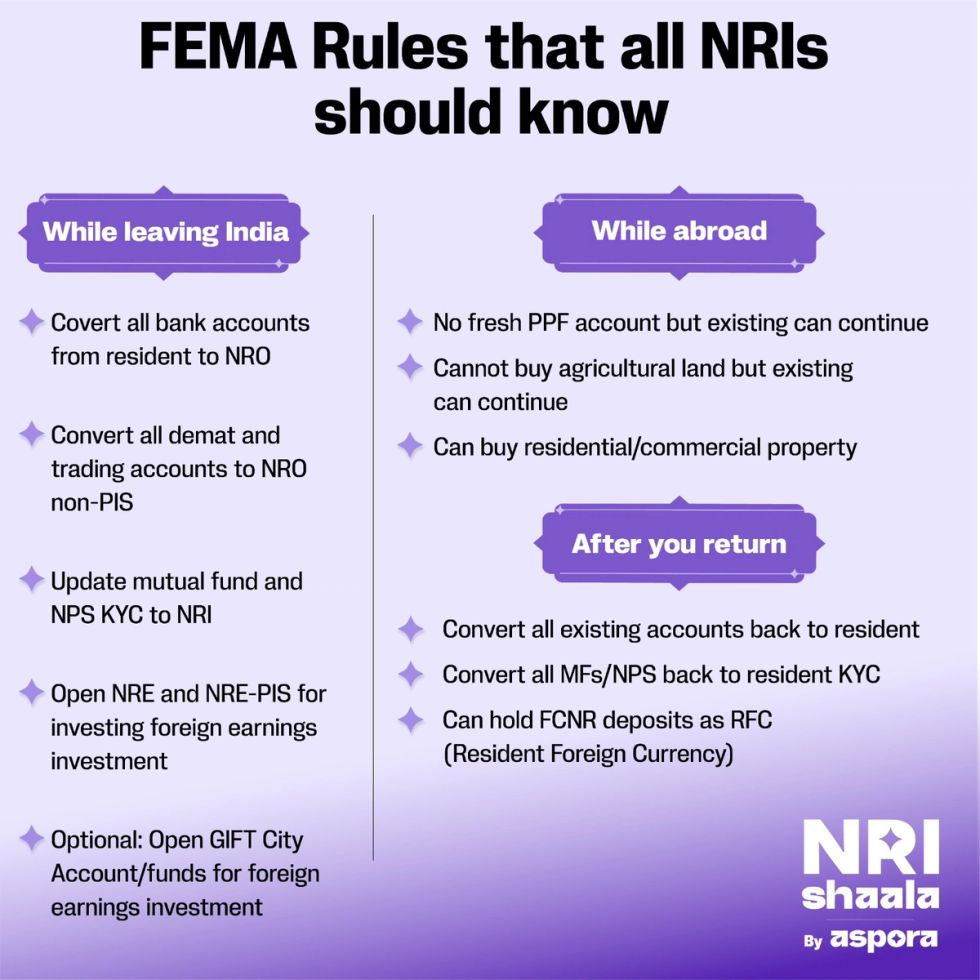
- When you leave India for an indefinite period such as taking up a job or you have married someone, you must convert your resident accounts to Non-Resident Ordinary (NRO). While there is no deadline specified, the burden placed upon you is to do it as soon as possible. Typically this means that you should do it as soon as you get a foreign address proof. Account conversion can be done by visiting your bank branch while on a visit to India or by couriering documents that are attested by the Indian consulate or a local notary.
- The same process of KYC update must be done for your stocks (NRO non-PIS) and mutual funds. You can also open an NRE account to hold your foreign earnings.
- Similarly you can open a Portfolio Investment Scheme (PIS) account for buying stocks through your foreign earnings. You cannot do any leverage (margin) trading in this account. Similarly, you cannot do futures and options trading through your PIS account but you can do it through your non-PIS account.
Other Investments
There are special rules governing other investments.
- NPS accounts can be continued while you are an Indian citizen.
- The PPF account can be continued and you can keep contributing to it (if opened while you were resident). However you cannot open a fresh PPF account.
- The EPF account can be continued but since fresh interest that accrues is taxable, it may be better to withdraw.
- You can continue to hold agricultural land bought while you were resident but cannot buy fresh agricultural land. You can freely purchase residential or commercial property.
While Coming Back to India
- You must reconvert your accounts back to resident upon returning to India.
- Similarly your demat and trading accounts must be converted back to resident status.
- Your foreign currency (FCNR) deposits can continue as Resident Foreign Currency (RFC) deposits. You can continue to hold foreign assets acquired while you were NRI - there is no obligation to bring them back to India. However you must report them every year in Schedule FA of your income tax return.
- Any inbound funds you have bought via GIFT city must be redeemed after you become resident again.
FEMA compliance isn't optional - it's a legal obligation that comes with changing your residency status. The rules may seem tedious, but ignoring them can lead to penalties, frozen accounts, and complications with your investments.
Whether you're moving to Dubai for work or returning to India after years abroad, make account conversions and KYC updates your first priority. Don't wait for your bank to remind you; they often won't. Set reminders, gather your documents, and get it done within a reasonable timeframe. When in doubt, consult a chartered accountant who specializes in NRI taxation and FEMA regulations - it's worth the investment to get it right the first time.
Most Asked Questions About FEMA Rules While Managing Investments
When exactly must I convert my resident account to NRO after moving abroad?
FEMA doesn't specify an exact deadline but requires you to do it "immediately" or "as soon as possible." In practice, convert your accounts within 30-60 days of getting proof of foreign residence (visa, work permit, or foreign address proof). Don't wait—non-compliance can lead to account freezing.
What's the difference between NRO and NRE accounts?
NRO (Non-Resident Ordinary) accounts hold your India-sourced income like rent or interest and are partially repatriable. NRE (Non-Resident External) accounts hold your foreign earnings converted to rupees and are fully repatriable and tax-free in India.
Can I convert my accounts remotely or must I visit India?
Most banks allow remote conversion through couriered documents attested by the Indian consulate in your country or a local notary. However, procedures vary by bank—some may require a branch visit. Check with your specific bank for their process.
What happens to my demat and trading accounts when I move abroad?
Your demat account must be converted to NRO non-PIS status for existing holdings. If you want to buy new stocks using foreign income, open a separate PIS account. Your trading account also needs KYC updates reflecting your NRI status.
Can I continue my PPF account after becoming an NRI?
Yes, if the account was opened while you were a resident, you can continue it and make contributions until maturity. However, you cannot open a fresh PPF account as an NRI. The account continues earning tax-free interest.
Should I withdraw my EPF after moving abroad?
It depends. You can continue the EPF account, but fresh interest earned becomes taxable as an NRI. Many NRIs choose to withdraw to avoid tax complications, but consider factors like your total income, tax bracket, and whether you need the liquidity.
Can I trade in futures and options as an NRI?
Yes, but only through your NRO non-PIS account, not through your PIS account. Your PIS account (for buying stocks with foreign earnings) doesn't allow F&O trading or margin/leverage trading. Delivery-based equity trading is allowed in both.
What must I do with my accounts when I return to India permanently?
Convert all NRO/NRE accounts back to resident savings accounts. Update your demat and trading accounts to resident status. Your FCNR deposits can continue as RFC (Resident Foreign Currency) accounts. Complete these conversions within a reasonable time after becoming resident.
Do I have to bring back my foreign assets when I return to India?
No. You can continue holding foreign bank accounts, properties, and investments acquired while you were an NRI. However, you must disclose them in Schedule FA (Foreign Assets) of your income tax return every year. Failure to disclose can result in penalties.
What happens to my GIFT City investments when I become resident again?
Any inbound funds (money brought from abroad) invested through GIFT City must be redeemed once you become a resident. GIFT City investments are specifically designed for non-residents, and regulations require redemption upon change of residency status.
Download the app