


The Ultimate 2026 Guide to GBP-to-INR Money Transfers

TL;DR: The best way to transfer GBP to INR is through a regulated digital platform that offers near-mid-market exchange rates, transparent fees, and fast delivery to Indian bank accounts or UPI — not a high-street bank that quietly takes 2–3% in exchange rate margin. This guide explains how exchange rates work, how to compare platforms accurately, what the regulations require, and how to ensure every pound you send delivers maximum rupees to your recipient.
Every year, billions of pounds flow from the UK to India — sent by NRIs and Global Indians supporting family, paying for education, managing property, and building a future across two countries. The UK–India remittance corridor is one of the largest in the world. And yet a significant portion of that money never actually arrives, quietly absorbed by exchange rate margins and fees that most senders never notice.
This guide is your straightforward breakdown of how to transfer GBP to INR in 2026 — and how to make sure every pound counts.
What Is the Best Way to Transfer GBP to INR?
The best way to transfer GBP to INR is through a regulated, digital-first transfer platform that uses near-mid-market exchange rates and charges transparent, low fees. For most NRIs in the UK, this means avoiding high-street bank wire transfers — which typically apply a 2–3% margin on top of the real exchange rate — in favour of specialist platforms that keep margins to 0.1–0.6%.
Aspora offers transfers at Google-matching exchange rates, meaning the rate you see on Google is the rate applied to your transfer. For someone sending £500 a month, the difference between a bank rate and a Google-matching rate can amount to hundreds of pounds saved over the course of a year.
Key factors to look for in a GBP to INR transfer service:
- Exchange rate margin — how close the offered rate is to the real mid-market (Google) rate
- Transfer fee — the flat or percentage charge per transaction
- Payout options — direct bank deposit or UPI in India
- Transfer speed — same-day, next-day, or 2–5 business days
- Regulation — FCA registration in the UK, compliance with Indian RBI and FEMA rules
Understanding GBP to INR Exchange Rates
The GBP to INR exchange rate tells you how many Indian Rupees you receive for each British Pound sent. The true benchmark is the mid-market rate — sometimes called the interbank rate — which is the midpoint between the buy and sell prices on global currency markets. It's what you see on Google and it represents the real value of the currency before any markup is applied.
Not all providers pass this rate on to you. Most add a margin — the gap between the mid-market rate and the rate they offer you. That margin is where the hidden cost lives.
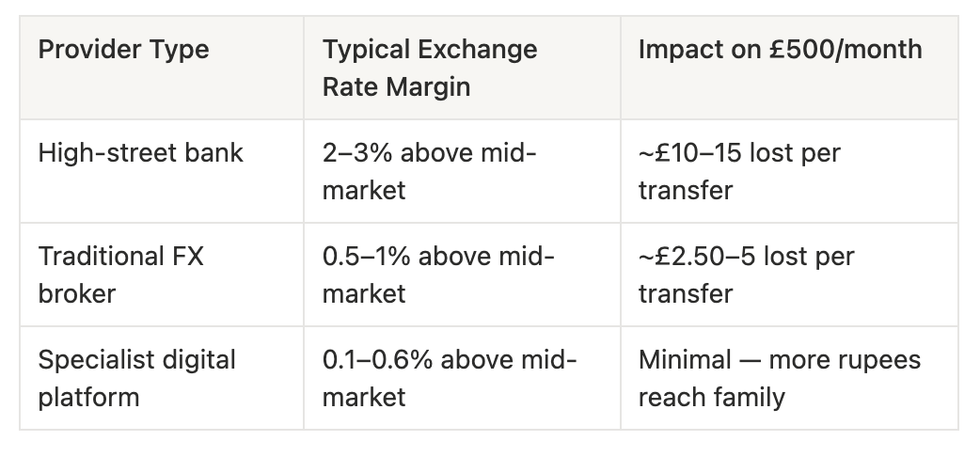
Even a 1% margin difference adds up quickly. For a remitter sending £300–£1,000 per month, that gap compounds into a meaningful sum over a year. Always compare the rate you're offered against the live mid-market rate on Google before confirming any transfer.
How to Compare Leading GBP to INR Transfer Platforms
Comparing platforms by advertised fee alone is a common and costly mistake. A 'zero fee' transfer service often recovers that cost through a 3–5% exchange rate margin — which can easily outweigh any savings. The only meaningful comparison is the total INR your recipient actually receives, after all fees and margins are deducted.
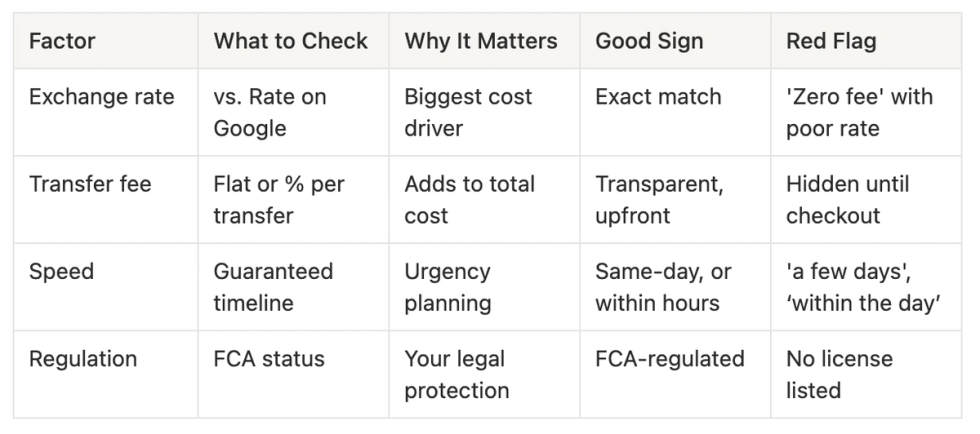
Run a live comparison on the day you plan to send. Rates fluctuate daily and the most accurate comparison is the actual INR that arrives in India.
Key Costs in GBP to INR Money Transfers
Every GBP to INR transfer involves both visible and invisible costs. Understanding both prevents unpleasant surprises.
The main cost components:
- Transfer fee — a flat charge (e.g., £2–£5) or a small percentage of the amount sent
- Exchange rate margin — the markup over the mid-market rate, often the largest cost and the least visible
- Correspondent bank fees — traditional SWIFT wire transfers may pass through intermediary banks, each deducting a small amount before funds reach India
To put this in perspective: reducing an exchange rate margin from 3% to 0.5% on a £1 million transfer saves over £25,000. For regular remitters, even the difference between a 2% and a 0.5% margin on monthly transfers adds up to hundreds of pounds per year.
Always evaluate your transfer by the final INR credited to your recipient's account — not by the headline fee on the transfer screen.
Payment and Delivery Methods for GBP to INR Transfers
How you fund the transfer and how your recipient receives INR affects both cost and speed.
- Bank transfer (SWIFT / Faster Payments) — secure and standard; SWIFT takes 2–5 business days, UK Faster Payments can be near-instant for supported corridors
- Debit or credit card — faster processing but may include additional funding fees
- Bank deposit — standard for larger or recurring amounts; supported by most regulated platforms
- Cash pickup — useful for recipients without bank accounts, though fees tend to be higher
For most UK-based NRIs sending to family or paying bills in India, a bank-funded transfer with a direct bank payout — as offered by Aspora — provides the best balance of cost, speed, and reliability.
Transfer Speed: What Affects How Quickly GBP Arrives as INR?
Transfer speed depends primarily on your chosen funding method, the platform's processing systems, and whether any compliance checks are triggered.
- SWIFT bank wire: typically 2–5 business days
- Dedicated digital remittance apps: often 24 hours or same-day for supported corridors
Faster options sometimes carry a slightly higher fee — worth it for emergencies, less so for routine transfers. For planned, recurring transfers, rate alerts allow you to send when the GBP to INR rate reaches a level you're comfortable with. With Aspora, your money reaches on time, no matter what the amount.
Regulatory and Tax Compliance for GBP to INR Transfers
Every GBP-to-INR transfer must comply with financial regulations in both the UK and India.
On the India side — FEMA and purpose codes:
The Foreign Exchange Management Act (FEMA, 1999), administered by the Reserve Bank of India (RBI), governs all inbound foreign currency flows into India. Every transfer must carry a purpose code — a five-digit classification describing the nature of the transfer (e.g., family maintenance, tuition, property purchase). Using an incorrect purpose code can delay or flag a transfer.
On the UK side:
The UK's Financial Conduct Authority (FCA) regulates money transfer operators and requires anti-money laundering checks, particularly for large or unusual transactions.
Documents typically required:
- Valid government-issued photo ID
- Recipient's full name, account number, IFSC code or SWIFT/BIC
- Purpose code for the transfer
- Proof of source of funds for large or business transfers
Keep all transfer receipts and confirmation documents until delivery is confirmed.
Choosing a Secure, Regulated Platform for GBP to INR Transfers
Regulation is your strongest protection when sending money internationally. A regulated provider is one that is licensed by the FCA in the UK and held to strict standards on anti-money laundering, data protection, and client fund handling.
Signs of a trustworthy platform:
- Visible FCA registration number or regulatory licence details
- Transparent pricing with real-time rate display before you confirm
- Live transaction tracking with reference numbers
- Clear customer support channels
Aspora operates under full regulatory oversight across its operating regions and is designed with a security-first approach — with compliance built into the transfer process.
Your GBP to INR Questions, Answered
1. What is the best way to transfer GBP to INR in 2026?
Regulated digital platforms that offer near-mid-market exchange rates consistently outperform high-street banks. Look for a service where the rate is close to what you see on Google, fees are shown upfront, and the platform is FCA-registered. Aspora offers Google-matching rates for UK to India transfers.
2. How do I compare leading GBP to INR transfer platforms?
Compare by the total INR your recipient receives after all fees and exchange rate margins — not by the advertised fee alone. Enter the same amount in two or three platforms on the same day and compare the final payout.
3. What are the typical fees and hidden costs in GBP-to-INR transfers?
Most providers charge a transfer fee plus an exchange rate margin. The margin — the gap between the real mid-market rate and what the provider offers — is often the largest cost and the least visible. Always check the effective rate against the live Google rate before sending.
4. How does the GBP to INR exchange rate affect my transfer?
A stronger GBP/INR rate means more rupees for your recipient. Even a 0.5% margin difference matters over time — for someone sending £500 a month, that gap can cost hundreds of pounds annually. Always compare rates against the mid-market benchmark.
5. How long do GBP-to-INR transfers take?
Transfer times range from near-instant (UPI payout, card-funded) to 2–5 business days (SWIFT bank wire). Digital remittance apps typically complete transfers within 24 hours for the UK-India corridor.
6. What documents do I need to send GBP to INR?
You'll need a valid photo ID, your recipient's full name, Indian bank account number and IFSC code or UPI ID, and a purpose code for the transfer. Large transfers may also require proof of source of funds.
7. What is a FEMA purpose code and do I need one?
Yes. FEMA (Foreign Exchange Management Act, 1999) governs all inbound transfers into India. Every transfer must carry a five-digit purpose code identifying the reason — family maintenance, education, property purchase, and so on. Incorrect codes can delay your transfer.
8. Is it safe to transfer large amounts from the UK to India?
Yes, provided you use an FCA-regulated platform with documented compliance processes. Keep all receipts, confirm the purpose code is accurate, and use a platform with transparent anti-money laundering procedures.
9. Bank account vs. UPI: which is better for receiving INR?
UPI is ideal for smaller, time-sensitive transfers — funds typically arrive within minutes once the transfer clears. A bank account is better for larger amounts or recurring transfers.
10. What are the best platforms for recurring GBP-to-INR transfers?
Look for platforms that support saved beneficiaries, automated scheduling, and rate alerts. Aspora offers scheduling tools built specifically for recurring UK-to-India remittances.
11. What payment methods are best for funding GBP-to-INR transfers?
Bank transfers via Faster Payments or BACS are typically the lowest-cost funding option. Debit and credit cards process faster but may carry additional fees.
12. How can I maximise the value of my GBP-to-INR transfers in 2026?
Use a regulated digital platform with near-mid-market exchange rates, fund via bank transfer to minimise fees, set rate alerts to send when the rate is strongest, and compare by total INR received. Aspora's tools are designed to make all of this straightforward for UK-based NRIs.
References
Download the app
We write to inform, not advise. The content in this article is for general awareness only and does not constitute financial, tax, or legal advice. Tax laws and financial regulations vary across jurisdictions and individual circumstances — what applies in one country may not apply in another. We assume no responsibility or liability for any decisions made based on the information provided here. Always consult a qualified professional before making any financial decisions.