


NRI Real Estate Investment India: FD, Flat, REIT or Fractional Ownership?

TL;DR
NRIs in the UK, UAE, and USA have four main ways to invest in Indian real estate in 2025: NRE fixed deposits (~7% gross, tax-free in India), a physical flat (~3% net rental yield plus appreciation), listed REITs (mid-to-high single-digit yields, fully liquid), and fractional ownership of Grade A commercial property (targeted low-teen returns, 4–7 year lock-in). There is no objectively best option — the right choice depends on your risk appetite, how much admin you want to handle, and how long you can lock your capital. This guide gives you the honest numbers on all four.
Every NRI group has that uncle. Beta, property hai best. FD is for scared people. Meanwhile your bank app is quietly showing 7% FD rates in India, your parents are nudging you to buy something back home, and you're sitting in London or Dubai or California with ₹50 lakh to ₹5 crore to deploy — with genuinely no clean answer.
This guide uses one anchor example — a ₹2.5 crore flat in Bengaluru — to make the numbers real, then expands into three other ways NRIs can play Indian real estate: traditional property ownership with some smart tax hacks, listed REITs you can buy from your DMAT account, and fractional ownership of Grade A commercial properties. By the end, you'll know exactly what you're signing up for in each bucket: the returns, the taxes in plain English, the liquidity, and the headache level.
Before we dive in, let's look at some quick definitions:
NRE FD — Fixed deposit in a Non-Resident External account: interest is tax-free in India, fully repatriable, and comes with no property management
REIT — Real Estate Investment Trust: a listed fund that owns income-generating properties and pays out rental income to investors; units trade on the stock exchange like shares
Fractional ownership — co-investing ₹10–25 lakh alongside other investors to own a share of a single high-value commercial property via a regulated platform
The Bar Fight: FD vs Flat
Let's pit ₹2.5 crore in both options and look honestly at what comes out.
Option A — NRE Fixed Deposit at 7%:
₹2.5 crore at 7% = approximately ₹17.5 lakh interest per year. After accounting for inflation (5–6% in India) and gradual rupee depreciation, your real return may feel closer to the mid-single digits over time. But the advantage is absolute: zero drama. No tenants, no brokers, no midnight calls about a broken geyser. You know exactly what lands in your account each year.
The quiet risk: money that feels safe is not always growing in real terms when inflation and currency movement are in play.
Option B — ₹2.5 Crore Flat in Bengaluru:
A flat in this range in a decent Bengaluru micro-market might fetch ₹65,000–₹75,000 per month in rent — roughly ₹8–9 lakh per year. On paper, that looks like 3.5–4% rental yield. But the word that matters is net. Factor in at least one empty month between tenants, society maintenance, periodic repairs, and broker fees — and your real, take-home rental yield drops to closer to 3% of property value.
So the actual comparison is: FD at roughly 5–7% effective return vs flat at ~3% net rent plus whatever appreciation you make on the property value.
And appreciation is where property makes itself impossible to argue against. Parts of Bengaluru saw 50–60% price growth in recent years — which is why your uncle is undefeatable at weddings. But two things matter: those are past numbers, not a guarantee. And when you eventually sell, you pay brokerage and capital gains tax — a headline 60% story can land closer to 40–45% in your pocket after costs.
The honest frame: FD is lower return but very low drama, quietly losing a little to inflation. A flat is potentially higher overall return if bought right and held for 10+ years — but with tenant management, paperwork, and price cycles to absorb. Even if the flat looks better on paper over 15 years, if you genuinely hate dealing with admin and uncertainty, that extra return may not be worth the stress.
Making Traditional Property Work Harder: The Smart Tax Hacks
Most NRIs don't arrive with a suitcase of cash. They take a home loan — and leverage changes the maths.
With a home loan, a portion of your monthly EMI is effectively funded by the tenant's rent. Month after month, you're converting the bank's money into your property equity. Leverage amplifies both upside and downside: if rents and prices cooperate, returns on your actual capital look significantly better. If they don't, you still owe the bank regardless of vacancy.
Three tax reliefs NRIs routinely miss:
- 30% standard deduction: 30% of your gross rental income is automatically treated as an expense. You are not taxed on the full rental amount — only 70% is treated as taxable income
- Home loan interest deduction: Under the old tax regime, interest is deductible up to ₹2 lakh per year (Section 24), with an additional ₹50,000 deduction on principal under Section 80C
- Budget 2026 update — pre-construction interest: Interest paid before possession or completion (pre-construction period) can now count toward the ₹2 lakh annual deduction limit from 1 April 2026. Previously, this interest had to be spread across five years after completion — the new treatment meaningfully softens the EMI hit for off-plan buyers
The NRI rental TDS reality many NRIs discover too late:
Your tenant is legally required to deduct TDS at 31.2% on rent before paying you (30% + surcharge and cess). On ₹1 lakh/month expected rent, roughly ₹68,800 actually hits your account. If your actual tax rate is lower than 31.2%, the fix is to apply for a lower TDS certificate (Form 13) via your CA — and give it to your tenant before rent payments start. Many NRIs discover this rule only after months of unnecessary over-deduction.
On selling in 2026: Budget 2026 has simplified the transaction for NRI sellers. Resident buyers purchasing your property no longer need a TAN to deduct TDS — they can now use their PAN and a standard challan. This reduces administrative back-and-forth and speeds up deal completion.
REITs: Indian Real Estate Without the Tenants
A REIT (Real Estate Investment Trust) is a listed fund that owns income-generating properties — office parks, malls, warehouses, and increasingly data centres — and distributes the majority of rental income back to unit holders.
For NRIs, an Indian REIT feels like this: you buy units through your DMAT account via a broker, just like buying shares. You receive periodic cash distributions proportionate to your holding (similar to receiving rent without owning a specific building). The unit price moves on the stock exchange based on market demand, interest rates, and the quality of the underlying portfolio.
Indian REITs currently offer mid-to-high single-digit yields from distributions, plus some price movement over time. They sit behaviorally between an FD and a small-cap stock.
Key advantages for NRIs:
- Diversification: risk is spread across many tenants and buildings — one bad tenant doesn't break the investment story
- Liquidity: sell some or all of your units in a few clicks through your broker; no property listing, negotiating, or registrar visits
- Zero management: no tenant calls, no maintenance coordination, no property managers to hire
The honest trade-off: Because REIT units trade daily, the price moves. If you check your portfolio ten times a day and feel anxious at a 3% dip, REITs will feel more stressful than an FD — even if the underlying rental income is steady. The volatility is on screen, not in the cash flows.
REITs work well for NRIs who want Indian real estate income exposure, don't want the management overhead of a physical property, and are comfortable with market-priced visibility in exchange for genuine liquidity.
Fractional Ownership: Grade A Commercial Without the Billions
Fractional ownership platforms slice a high-value commercial property — say, a Grade A office building worth ₹100 crore, fully leased to a well-known MNC on a long-term lease — into smaller co-investment fractions. As an NRI, instead of needing ₹20–30 crore to buy the whole building, you can participate from ₹10–25 lakh in a single deal.
The tenant pays rent, platform expenses are deducted, and your share of net income flows to you — along with a share of the capital gain when the property is eventually sold.
Compared to residential flats, Grade A commercial properties often offer higher rental yields — corporate leases pay more per square foot and lock in for longer terms. Targeted annualised returns in the low teens are commonly cited in platform marketing materials. Compared to REITs, fractional deals are more concentrated — you're picking a specific building in a specific location, not a diversified basket.
Three risks to understand before committing:
- Property risk: if that particular building or micro-market underperforms, you feel it directly — there's no portfolio cushion
- Tenant risk: if the anchor tenant vacates, income drops while a replacement is found — and re-letting a large commercial floor can take months
- Platform risk: you are relying on the platform to source assets well, structure deals cleanly, handle regulatory compliance, and manage the property throughout the hold period
Liquidity is fundamentally different from REITs. You cannot press sell and exit in seconds. Your exit depends on the platform arranging a secondary buyer, a resale window, or a final property sale — typically after 4–7 years. If having capital locked for that period feels uncomfortable, fractional should stay on your watch list rather than in your portfolio.
The 4-Bucket Self-Diagnosis
Use this not as a ranking, but as a mirror — to find which column most closely matches where you are right now.
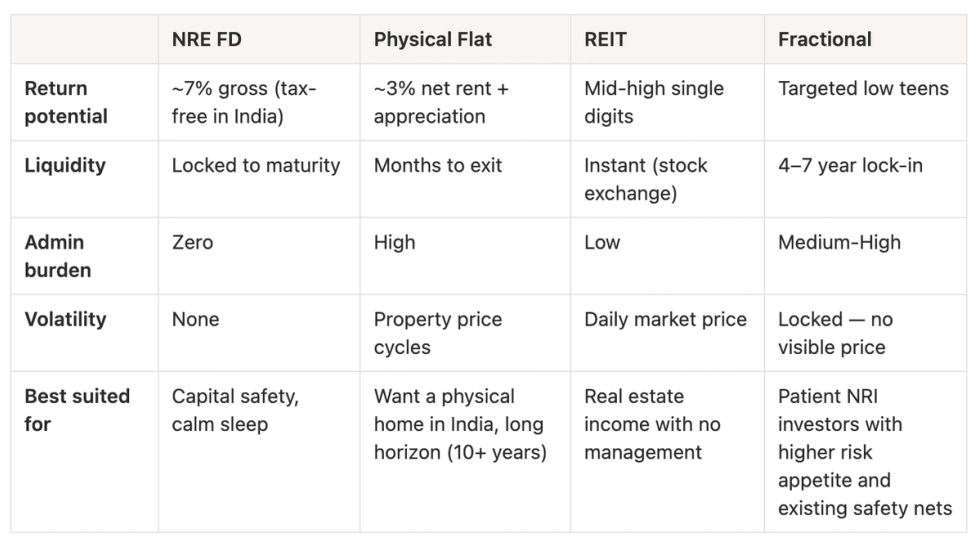
A few self-diagnosis questions:
- 35 years old, busy career in Dubai, hate tenant calls? → Tilt toward REITs for income exposure; consider a small, carefully chosen fractional allocation if you can genuinely lock the capital
- Want to move back to India in 10 years and live in the property? → Leveraged flat with smart tax use can be powerful — the appreciation upside is real if bought in a quality micro-market
- Near retirement, prioritising capital safety? → NRE FDs with a modest REIT allocation is far more sensible than chasing fractional double-digit returns with capital you might need
The right answer is the column that matches your life stage, your genuine risk appetite, your time horizon, and your tolerance for admin. Use this framework as the starting point for a conversation with a qualified adviser who understands both Indian rules and the tax rules in your country of residence.
Moving Your Money to India for Property Investment
Whether you're paying a booking amount on an off-plan flat, making stage payments during construction, transferring funds to an NRE account for a REIT purchase, or consolidating capital before a large investment — you'll be moving meaningful sums from abroad. With Aspora, you can transfer money from the UK, UAE, and USA to India at Google-matching exchange rates — no margin built into the rate.
Frequently Asked Questions
1. What is the best way for NRIs to invest in Indian real estate?
There is no single best option — it depends on your situation. NRE FDs offer ~7% with zero hassle. A physical flat offers ~3% net yield plus appreciation over 10+ years but requires active management. REITs offer real estate income with stock-market liquidity. Fractional ownership targets higher returns but locks capital for 4–7 years. Match the option to your risk appetite, time horizon, and admin tolerance.
2. What is the actual net rental yield on property in India for NRIs?
A ₹2.5 crore flat in Bengaluru typically earns ₹65,000–75,000 per month gross. After vacancy (one month per year average), maintenance, broker fees on tenant changes, and minor repairs, the real net yield is typically closer to 3% of property value — not the headline 3.5–4%.
3. How is NRI rental income from Indian property taxed in India?
30% of gross rental income is automatically treated as an expense (standard deduction under Section 24). The remaining 70% is taxable income. Your tenant must deduct TDS at 31.2% on rent before paying you. If your actual tax rate is lower, apply for a lower TDS certificate (Form 13) via your CA and provide it to your tenant.
4. What are the Budget 2026 changes that affect NRIs investing in property?
Two key changes: (1) Pre-construction interest can now count toward the ₹2 lakh annual home loan interest deduction from 1 April 2026 — softening the EMI burden for off-plan buyers under the old tax regime. (2) Resident buyers purchasing from NRI sellers no longer need a TAN for TDS deduction — they can use PAN with a standard challan, simplifying the transaction.
5. What are REITs and how can NRIs in the UK, UAE, or USA invest in them?
REITs (Real Estate Investment Trusts) are listed funds owning income-generating properties that distribute rental income to investors. NRIs can invest through a DMAT account with a SEBI-registered broker, just like buying shares. They offer diversification, regular income distributions, and the ability to sell units instantly on the stock exchange.
6. What is fractional ownership in Indian real estate?
Fractional ownership platforms allow NRIs to co-invest in high-value commercial properties with amounts from ₹10–25 lakh, rather than the ₹20–30 crore needed to own a whole building. Investors receive proportionate rental income and a share of capital gains on sale, typically after a 4–7 year hold period.
7. What are the risks of fractional ownership for NRIs?
Three layered risks: property risk (specific building underperformance), tenant risk (income drops when anchor tenant vacates and re-letting takes time), and platform risk (reliance on the operator for asset selection, compliance, and management quality). Liquidity is very limited — exit depends on platform-arranged transactions, not a click.
8. Should NRIs invest in a flat or REITs in India?
A flat makes sense for NRIs who want a physical home in India, can commit to 10+ years, and are comfortable with property management (directly or via a professional manager). REITs make more sense for NRIs who want Indian real estate income without the management overhead, or who value the ability to exit quickly. The choice comes down to your management appetite and liquidity needs.
9. What is the TDS on rent for NRIs with property in India?
Your tenant must deduct TDS at 31.2% (30% base rate + cess) before paying rent. On ₹1 lakh/month rent, approximately ₹68,800 reaches your account. If your actual tax liability is lower, apply for a lower deduction certificate (Form 13) through your CA and provide it to your tenant before payments begin.
10. What is capital gains tax for NRIs selling property in India in 2025?
Long-term capital gains (property held over 24 months): taxed at 20% with indexation benefit under Section 112. Short-term capital gains (held 24 months or less): taxed at your income tax slab rate. DTAA provisions between India and the UK, UAE, or USA may reduce the effective rate — consult a CA for your specific situation.
11. Are NRE fixed deposits better than property investment for NRIs?
NRE FDs offer ~7% interest, which is tax-free in India, with full repatriability and zero management. Property offers ~3% net rental yield plus potential appreciation, but requires ongoing management and has illiquidity on exit. FDs offer predictability and simplicity; property offers higher potential upside with higher complexity and a longer required horizon.
12. Should NRIs use the old or new tax regime for property with a home loan?
For most NRIs investing in property with a home loan, the old tax regime remains more beneficial. It allows home loan interest deductions (up to ₹2 lakh/year), the 30% standard deduction on rental income, and Budget 2026's pre-construction interest benefit. The new default regime for 2026 does not allow home loan losses to be set off against salary income. Always confirm with a qualified CA.
References
- Reserve Bank of India — FEMA guidelines on immovable property acquisition and transfer by NRIs
- Income Tax Act, 1961 — Section 195 (TDS on payments to non-residents), Section 112 (long-term capital gains), Section 24 (home loan interest deduction), Section 10(4)(ii) (NRE interest exemption)
- Union Budget 2026-27 — Pre-construction interest deduction amendments and TDS simplification for NRI property sellers
- SEBI — Real Estate Investment Trust (REIT) Regulations
Download the app
We write to inform, not advise. The content in this article is for general awareness only and does not constitute financial, tax, or legal advice. Tax laws and financial regulations vary across jurisdictions and individual circumstances — what applies in one country may not apply in another. We assume no responsibility or liability for any decisions made based on the information provided here. Always consult a qualified professional before making any financial decisions.