


NRI FEMA Penalties: 5 Compliance Mistakes to Avoid

TL;DR
India's FEMA regulations carry penalties of up to ₹5,000 per day for non-compliance — and most NRIs don't realise they're already in violation. From keeping a resident savings account after moving abroad to missing ITR deadlines, these 5 penalties affect NRIs in the UK, UAE, and USA. Every single one is avoidable once you know the rules.
Why This Catches So Many NRIs Off Guard
You moved to London, Dubai, or New York. You're focused on your career, supporting family back home, maybe planning to return one day. India's financial rules feel like something to deal with later.
That's exactly when FEMA, the Income Tax Act, and the Black Money Act start running up the clock.
Think of Indian financial compliance like a passport stamp. Every time you cross a financial border — opening an account, sending money, earning income in India — there's a record. Ignore the process long enough and you don't just get stopped at customs. You get flagged for every crossing you ever made.
Here are the five penalties that catch NRIs off guard, what they actually cost, and exactly how to fix them.
Penalty 1: Keeping Your Resident Savings Account After Becoming an NRI
The moment you qualify as an NRI — defined under FEMA as someone who has spent more than 182 days outside India in a financial year — your resident savings account must be converted to an NRO account or closed. Not after a year. Not when it's convenient. Immediately.
Most NRIs don't do this. Their bank may not send a reminder. The account keeps receiving salary credits or family transfers. Life moves on.
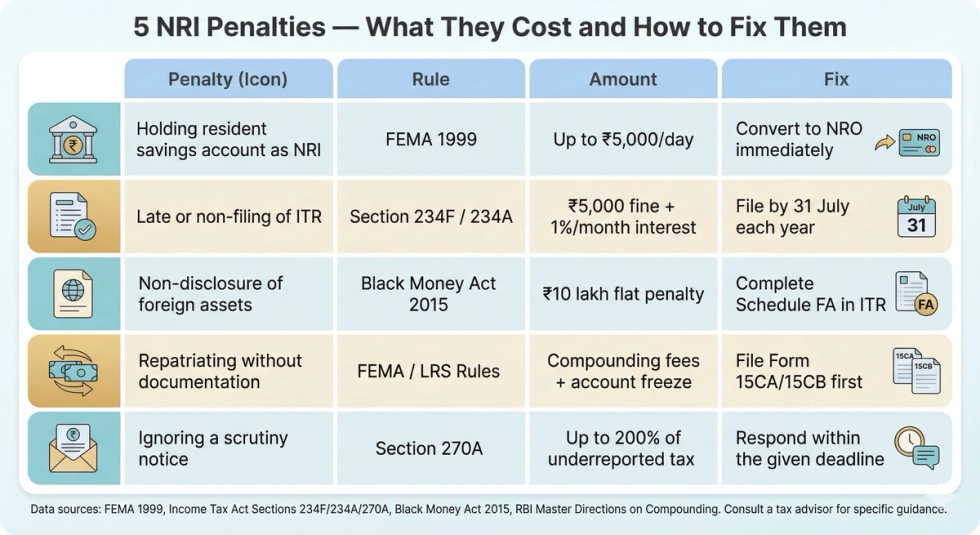
Under FEMA, holding a resident account as an NRI is an ongoing contravention. The penalty can reach ₹5,000 per day for every day the violation continues, plus up to three times the sum involved. Because the violation compounds daily, it can quietly build into a significant liability before anyone notices.
The fix: Contact your Indian bank and submit a copy of your passport, visa, and overseas address proof to convert the account to NRO. Many banks allow this online. Do it as soon as you become an NRI — don't wait for the bank to prompt you.
Penalty 2: Not Filing Your ITR When Required
Here's a myth that costs NRIs every year: "I live abroad, so I don't need to file an income tax return in India."
You're required to file if your India-sourced income crosses the basic exemption threshold. That includes NRO account interest, rental income from Indian property, capital gains from shares or mutual funds, or any business income earned in India. NRE account interest is tax-free and doesn't count — but almost everything else does.
Miss the deadline and Section 234F applies: a ₹5,000 late fee (or ₹1,000 if your income is below ₹5 lakh). On top of that, Section 234A charges 1% interest per month on any unpaid tax, calculated from the due date until you pay. These stack up faster than expected.
The fix: Each year, check whether your India-sourced income crosses ₹2.5 lakh. If it does, file your ITR by 31 July. NRIs can file online through the Income Tax India portal using their PAN and Aadhaar-linked mobile number.
Penalty 3: Skipping Schedule FA — The Foreign Assets Disclosure
This is the penalty that surprises people the most. If you're an NRI who files an ITR — even just for rental income — you must also disclose your foreign assets in Schedule FA. This covers overseas bank accounts, property, investments, stocks, and any beneficial ownership in foreign entities.
Non-disclosure isn't just an oversight fine. Under the Black Money (Undisclosed Foreign Income and Assets) Act 2015, the penalty is a flat ₹10 lakh per undisclosed asset, plus the possibility of prosecution. The law was designed to catch large-scale tax evasion, but it catches NRIs who simply didn't know the form existed.
The fix: If you're filing an ITR and you hold assets abroad, complete Schedule FA before submitting. If you have significant overseas holdings, engage an NRI-specialist CA to ensure the disclosure is accurate and complete.
Penalty 4: Repatriating Money Without the Right Documentation
NRIs can repatriate up to USD 1 million per financial year from their NRO account — but only with the correct paperwork. Before transferring large sums out of India, you need a certificate from a chartered accountant (Form 15CA/15CB) confirming that applicable taxes have been paid or aren't due. Your bank won't process the transfer without it.
Sending money without this documentation — or exceeding repatriation limits — is a FEMA contravention. The consequences: compounding fees, potential freezing of the account, and scrutiny of your full transaction history going back years.
The fix: Before repatriating significant funds from your NRO account, ask your CA to file Form 15CA/15CB. For recurring transfers, build this into your process upfront — don't treat it as a one-off administrative step.
Penalty 5: Ignoring a Tax Scrutiny Notice
Every year, the Income Tax Department sends notices to NRIs — triggered by large NRO transactions, undisclosed rental income, or discrepancies between TDS records and filed returns. Ignoring one is the costliest mistake of all.
A notice left unanswered leads to a best-judgement assessment, where the tax officer estimates your liability without your input. That estimate is never generous. Add Section 234A interest and Section 270A penalties — which can reach 200% of the underreported tax in cases of concealment — and a manageable query becomes a serious bill.
The fix: All notices are accessible on your Income Tax India portal account. Check it at least once a quarter. If you receive a notice, respond within the deadline (usually 15–30 days). For complex matters, engage an NRI tax specialist rather than navigating it alone.
The 5 Penalties at a Glance
One Thing That Makes Compliance Easier: Transfers Done Right
FEMA violations often begin with informal transfers — money sent through contacts, cash networks, or channels that don't document the source, purpose, or amount. These are exactly the transfers that attract scrutiny.
Aspora lets NRIs in the UK, UAE, and US send money to India at Google-matching rates, through fully compliant bank-to-bank transfers.
If you're managing India finances from abroad, starting with clean, documented transfers is the right foundation.
🇬🇧 UK to India: Send money from the UK to India at Google-matching rates →
🇺🇸 US to India: Send money from the US to India at Google-matching rates →
🇦🇪 UAE to India: Send money from the UAE to India at Google-matching rates →
Your NRI Compliance Questions, Answered
1. What is FEMA and which NRIs does it apply to?
FEMA — the Foreign Exchange Management Act 1999 — governs all foreign exchange transactions involving India. It applies to all Indian citizens living abroad and to foreign nationals with financial interests in India. If you hold Indian bank accounts, own property, or earn income in India, FEMA applies to you.
2. What happens if I keep my resident savings account after becoming an NRI?
It becomes a FEMA contravention the day you qualify as an NRI. The penalty can reach ₹5,000 per day for every day the violation continues, plus up to three times the amount in the account. Convert it to an NRO account as soon as your NRI status begins.
3. Do I have to file an ITR in India as an NRI?
Yes, if your India-sourced income exceeds the basic exemption limit (currently ₹2.5 lakh). This includes NRO interest, rental income, capital gains from Indian investments, and any business income from India. NRE account interest is tax-free and does not count toward the threshold.
4. What is the Section 234F penalty for late ITR filing?
₹5,000 if your total income is above ₹5 lakh, or ₹1,000 if it's below. Section 234A then adds 1% interest per month on any unpaid tax, running from the original due date until full payment.
5. What is Schedule FA and what happens if I don't fill it in?
Schedule FA is the section of India's ITR form where you declare all foreign assets — bank accounts, property, shares, and beneficial interests. If you're an NRI filing an ITR and you hold overseas assets, it's mandatory. Non-disclosure carries a flat ₹10 lakh penalty under the Black Money Act, and potential prosecution in serious cases.
6. What is the Black Money Act and can it apply to NRIs?
Yes. The Black Money (Undisclosed Foreign Income and Assets) Act 2015 applies where Indian residents — and in some cases non-residents — have undisclosed foreign income or assets that should have been declared in India. The penalty is ₹10 lakh per undisclosed asset, with possible criminal prosecution.
7. Can the Income Tax Department issue a notice to an NRI living abroad?
Yes. Notices are sent to your registered Indian address and are visible on your Income Tax India portal account. Notices sent via email and SMS to your registered contact details are also legally valid. Claiming you didn't receive a physical notice is not a defence.
8. How much is the FEMA penalty for holding a resident account as an NRI?
A FEMA compounding application is a formal request to the RBI or Enforcement Directorate to settle a violation by paying a negotiated penalty, rather than going through full adjudication. It's the most practical route for NRIs who discover a historic FEMA violation and want to regularise their position without drawn-out legal proceedings.
10. How do I know if I'm already in violation of FEMA or the Income Tax Act?
Review three things: (1) check whether your resident savings account has been converted to NRO, (2) check whether you've filed ITR for years where you had India-sourced income above the threshold, and (3) check whether you declared foreign assets in Schedule FA. If any of these are missing, consult an NRI tax specialist.
11. Can I fix past non-compliance without paying the full penalty?
In most cases, yes. FEMA violations can be settled through compounding. Missed ITR filings can be remedied by filing belated or updated returns within the permitted window. The Income Tax Act also allows voluntary disclosure. Proactive action consistently results in lower penalties than waiting to be caught.
12. How do NRIs in the UK, UAE, and USA stay compliant with India's financial rules?
Five steps cover most of it: convert your resident accounts to NRO/NRE on becoming an NRI, file ITR if you have India-sourced income above the threshold, declare foreign assets in Schedule FA, use Form 15CA/15CB for NRO repatriations, and check your Income Tax India portal quarterly for notices. A good NRI-specialist CA makes all five manageable.
References
- Foreign Exchange Management Act 1999 (FEMA) — Ministry of Finance, Government of India
- Income Tax Act 1961 — Sections 234A, 234F, 270A — Income Tax India
- Black Money (Undisclosed Foreign Income and Assets) and Imposition of Tax Act 2015
- RBI Master Direction — Compounding of Contraventions under FEMA 1999
Download the app
We write to inform, not advise. The content in this article is for general awareness only and does not constitute financial, tax, or legal advice. Tax laws and financial regulations vary across jurisdictions and individual circumstances — what applies in one country may not apply in another. We assume no responsibility or liability for any decisions made based on the information provided here. Always consult a qualified professional before making any financial decisions.