


NRE vs NRO Account: 7 Things Every NRI Must Know About Indian Banking

TL;DR
The moment you move abroad, your Indian resident savings account becomes illegal under FEMA — you must convert it immediately or face penalties of up to ₹2 lakh plus ₹5,000 per day. NRE accounts hold foreign-sourced income and earn tax-free interest in India. NRO accounts hold India-sourced income like rent and are taxed at 30% TDS. Most NRIs need both. This guide covers all 7 things — from account conversion to using DTAA to avoid double taxation.
Romesh moved to Dubai on a Tuesday. By Friday, every transaction from his regular Indian savings account was technically a FEMA violation. He didn't know. Most NRIs don't.
The penalty? Up to three times the amount involved — or ₹2 lakh if unquantifiable — plus ₹5,000 per day of ongoing violation. A small administrative oversight can become a very expensive problem.
Here are the 7 things every NRI must know to manage Indian bank accounts legally, efficiently, and safely from abroad.
Before we dive in, let's look at some quick definitions:
NRI — Non-Resident Indian: an Indian citizen residing abroad for 182+ days in a financial year
FEMA — Foreign Exchange Management Act, 1999: India's law governing all cross-border financial transactions
NRE — Non-Resident External account: holds foreign income, tax-free in India, fully repatriable
NRO — Non-Resident Ordinary account: holds India-sourced income (rent, dividends), taxed at 30% TDS
FCNR — Foreign Currency Non-Resident deposit: fixed deposit in USD/GBP/AED, no rupee depreciation risk
1. Your Resident Savings Account Becomes Illegal the Day You Move Abroad
This is not a technicality. FEMA mandates that once you become an NRI, your Indian resident savings account must be converted to an NRE or NRO account immediately. Using a resident account while living abroad is a FEMA violation from Day 1 — regardless of whether you know the rule.
The reason: the Reserve Bank of India (RBI) needs to track the source and movement of NRI money for tax compliance, anti-fraud, and anti-money laundering purposes. A resident account operating from Dubai or London raises red flags in their systems.
Action step: Contact your bank's NRI cell the week you move. Most banks convert the account without closing and reopening it. Don't delay — the penalty clock starts from the day you become an NRI.
2. Documents Needed to Open or Convert Your NRI Account
To open or convert to an NRE or NRO account, you need: valid passport, visa or OCI card, PAN card, overseas address proof (utility bill or bank statement), and Indian address proof.
The step NRIs most often miss: documents must be notarised and attested. This means visiting a local notary or the Indian consulate in your country of residence. Some banks now offer digital KYC — but a physical signature is usually still required.
Don't skip attestation. Banks that process conversion without properly attested documents can flag accounts during audits, creating compliance problems later.
3. NRE vs NRO vs FCNR — Know Which Account Does What
Think of it this way:
- NRE = your international wallet — for money earned abroad that you want to hold in India
- NRO = your India locker — for money earned in India (rent, dividends, pensions)
- FCNR = your foreign currency vault — for savings you don't want converted to rupees
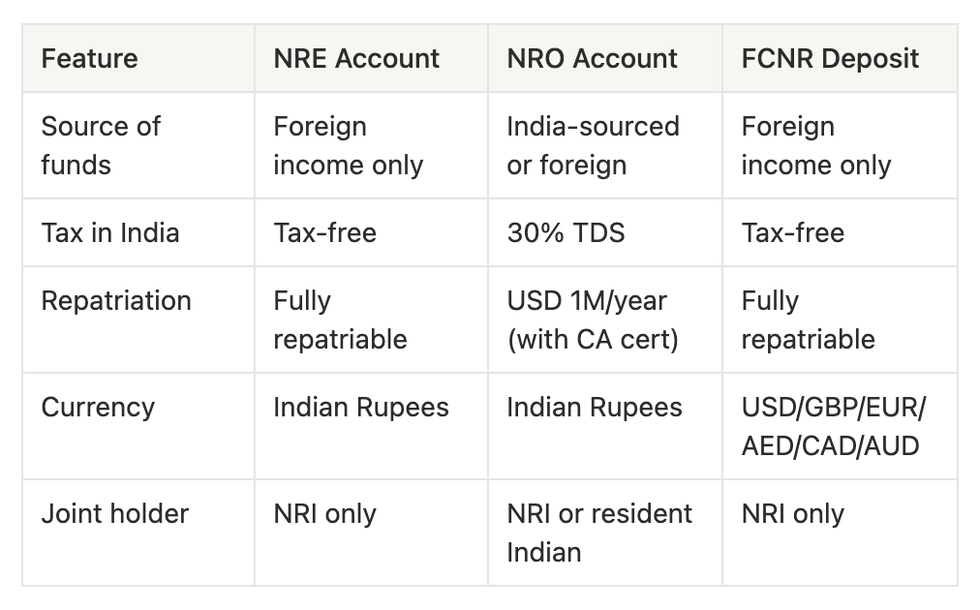
Source: RBI Master Direction on Non-Resident Indian Accounts
Note on joint holding: NRO accounts can include a resident Indian joint holder — useful if a family member needs direct access for emergencies. NRE accounts can only be jointly held with another NRI.
4. Repatriation Rules: How Much Can You Move Back Abroad?
This is where many NRIs get caught out.
Current income (interest, dividends, rent): After paying applicable Indian tax, there is no cap on repatriation. If Romesh earns ₹2 lakh in rental income taxed at 31.2%, the after-tax net can go abroad without limit.
Capital amounts in your NRO account (e.g., property sale proceeds): capped at USD 1 million per financial year. To remit this, you need Form 15CA filed online and Form 15CB certified by a CA, plus proof of source and tax compliance.
NRE accounts: fully repatriable, no limit, no special paperwork beyond standard KYC. This is why keeping foreign earnings in NRE — not NRO — matters for long-term flexibility.
5. Protect Your Accounts from SIM Swap and Digital Fraud
NRI bank accounts are a prime target. The most common attack is SIM swap fraud: criminals gather personal information from social media or data leaks, impersonate you to your telecom provider, take control of your mobile number, and intercept OTPs to access your accounts.
What to do:
- Switch from SMS-based OTPs to app-based authenticators (Google Authenticator, Authy)
- Enable real-time email alerts for every transaction
- Keep KYC details updated — outdated details trigger account review flags
- Scrutinise every investment offer before engaging; phishing emails and fake property schemes specifically target NRIs
6. Don't Let Your Accounts Go Dormant
The RBI has reported that over ₹3,400 crore of inactive NRI deposits were transferred to government protection schemes — without account holders realising it. Accounts become dormant when there are no transactions for 2 years. This doesn't just lock your money; it creates complications when you eventually need access.
Action step: Make at least one small transaction per account per year — even an internal rupee transfer counts. Set a calendar reminder. Update contact details and KYC proactively. Dormant accounts are a quiet risk that most NRIs only discover in an emergency.
7. Use DTAA to Avoid Paying Tax in Two Countries
If you have India-sourced income — NRO interest, rent, dividends — India deducts TDS. Your country of residence may also tax the same income. The solution is the Double Taxation Avoidance Agreement (DTAA).
India has DTAAs with 90+ countries including the UK, UAE, and USA. To claim benefits, you need:
- Tax Residency Certificate (TRC): Issued by your country's tax authority (HMRC in the UK, Federal Tax Authority in UAE, IRS Form 6166 in USA)
- Form 10F: Self-declaration filed on India's income tax e-filing portal
Submit both to your Indian bank or income payer to get TDS reduced at source. Without them, banks deduct at the full 30% rate. You can claim a refund via ITR — but submitting upfront is far simpler. File both documents annually.
Managing Your NRE Account Starts with the Transfer
Every remittance into your NRE account begins with the exchange rate. Aspora lets you transfer money from the UK, UAE, and USA to India at Google-matching exchange rates, no hidden fees — so the amount that leaves your account is the amount that lands in India.
Frequently Asked Questions
1. What is the difference between NRE and NRO accounts?
NRE accounts hold money remitted from abroad — interest is tax-free in India and funds are fully repatriable. NRO accounts hold India-sourced income like rent or dividends — interest is taxed at 30% TDS and repatriation is limited to USD 1 million per year with Form 15CA/15CB certification.
2. From what day must I convert my resident account to NRE/NRO?
Immediately from the day you become an NRI. Using a resident savings account while living abroad is a FEMA violation from Day 1. Contact your bank's NRI cell as soon as you relocate.
3. What penalty applies for not converting my resident account?
FEMA penalties can be up to three times the amount involved — or ₹2 lakh if unquantifiable — plus ₹5,000 per day of ongoing violation. Account freezing or closure is also possible.
4. Can I have both NRE and NRO accounts at the same time?
Yes. Most NRIs with any India-sourced income need both. NRE for foreign earnings; NRO for India-sourced income. There is no regulatory restriction on holding both simultaneously.
5. What documents do I need to open an NRI account from abroad?
Valid passport, visa or OCI card, PAN card, overseas address proof (utility bill or bank statement), and Indian address proof. Most documents require notarisation and attestation by the Indian embassy, consulate, or a local notary.
6. What is an FCNR deposit and when does it make sense?
FCNR (Foreign Currency Non-Resident) is a fixed deposit held entirely in foreign currency — USD, GBP, EUR, AED, CAD, or AUD. Tax-free in India and fully repatriable, like an NRE FD — but eliminates rupee depreciation risk. Best for NRIs planning to spend savings abroad rather than in India.
7. How much NRO money can I repatriate per year?
Up to USD 1 million per financial year, after paying applicable Indian taxes and submitting Form 15CA and Form 15CB certified by a CA. Current income — interest, dividends, rent — is separately repatriable in full after tax, without this annual cap.
8. What is Form 10F and when do I need it?
Form 10F is a self-declaration filed on India's income tax e-filing portal alongside your Tax Residency Certificate (TRC) to claim DTAA benefits. It is submitted to your Indian bank or income payer to reduce TDS deducted at the full rate.
9. Can my family in India operate my NRE/NRO account?
Yes, via a registered Power of Attorney (PoA). The PoA holder is restricted to local Indian transactions — they cannot initiate international remittances or repatriate funds abroad. NRO accounts can also be jointly held with a resident Indian for day-to-day local access.
10. What is SIM swap fraud and how do I protect my NRI accounts?
SIM swap is when criminals impersonate you to your telecom provider to take over your mobile number, then use it to intercept banking OTPs. Protect yourself by switching to app-based authenticators, enabling email transaction alerts, and keeping bank KYC details updated.
11. How do I prevent my NRI account from going dormant?
Make at least one transaction per account per year. Update contact details and KYC documents proactively. Accounts with no transactions for 2 years are classified as dormant, and unclaimed funds can be transferred to the RBI's Depositor Education and Awareness Fund.
12. What happens to my NRE and NRO accounts when I return to India?
When you become a resident Indian, you must notify your bank and convert both accounts to resident savings accounts. NRE FDs can continue to maturity, but interest earned after your return date becomes taxable. You may also convert NRE funds to an RFC (Resident Foreign Currency) account to retain foreign currency holdings.
References
Download the app
We write to inform, not advise. The content in this article is for general awareness only and does not constitute financial, tax, or legal advice. Tax laws and financial regulations vary across jurisdictions and individual circumstances — what applies in one country may not apply in another. We assume no responsibility or liability for any decisions made based on the information provided here. Always consult a qualified professional before making any financial decisions.