


DTAA Explained: How NRIs Legally Avoid Double Taxation

TL;DR
A DTAA (Double Taxation Avoidance Agreement) is a treaty between two countries that determines where each type of income is taxed — preventing you from paying full tax in both. India has DTAAs with over 90 countries including the UK, USA, and UAE. To claim DTAA relief in India, you need a Tax Residency Certificate (TRC) from your country of residence and Form 10F filed with Indian tax authorities. Without these documents, Indian banks and payers will deduct TDS at the full rate.
Two countries. Two tax authorities. One income. That's the scenario millions of NRIs face — and the scenario that DTAA was designed to prevent.
If you earn a salary in the UK, rent from a flat in Pune, and dividends from Indian stocks, you could theoretically owe tax to HMRC and the Indian Income Tax Department on overlapping income. The DTAA is the legal mechanism that stops that from happening. Understanding how it works — and more importantly, how to claim it — can make a significant difference to your tax bill.
What Is a DTAA and How Does It Work?
A DTAA is a bilateral tax treaty between two countries. It sets out, for each type of income, which country has the primary right to tax, and ensures that income taxed in one country receives relief in the other.
India has DTAAs with over 90 countries, including the UK, UAE, USA, Canada, Australia, Singapore, and Germany. Each treaty is negotiated separately and has its own specific provisions — the India-UK DTAA differs from the India-UAE DTAA in important ways.
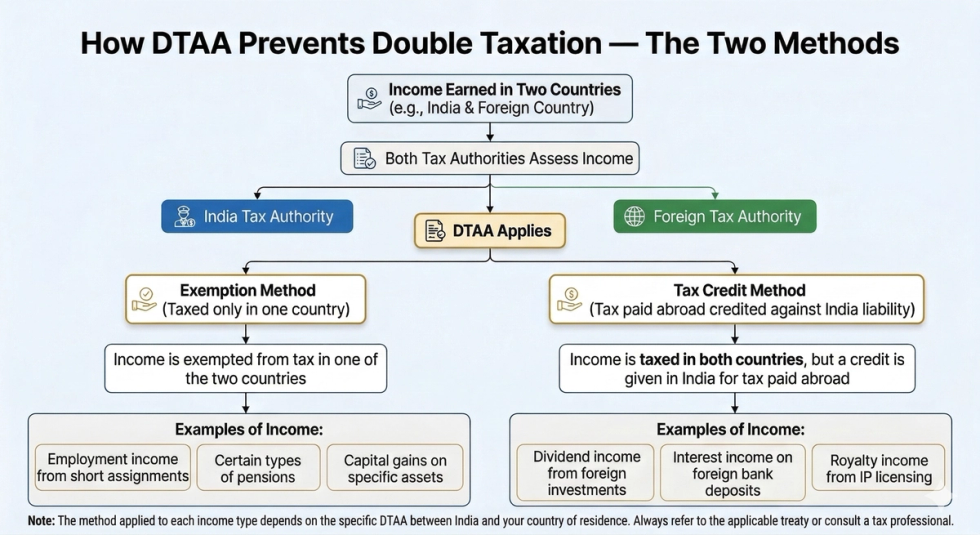
The two relief methods used in DTAAs
1. Exemption Method: Income is taxable only in one country and fully exempt in the other. For example, under the India-UAE DTAA, certain income types may be taxable only in the UAE — but since the UAE has no income tax, the practical result is that this income is taxed nowhere.
2. Tax Credit Method: Income is taxable in both countries, but the tax paid in one country is credited against the tax liability in the other. So if you paid 20% tax in the UK on rental income from India, India will allow a credit for that 20% against your Indian tax liability on the same income.
India-UK DTAA: Key Points for UK-Based NRIs
The India-UK DTAA covers most common income types. Key provisions:
Salary income: Generally taxable in the country where the work is performed. If you work in the UK and are paid by a UK employer, your salary is taxable in the UK — not in India.
Pension income: Government pensions are generally taxable only in the country that pays them. Private or employer pensions may be taxable in India if you're a resident there.
Rental income from Indian property: Taxable in India (where the property is located). The UK may also tax this, but a credit for Indian tax paid is available under the treaty.
Interest and dividends: May be taxed in both countries, with credit available in the country of residence. Withholding tax rates are limited by the treaty.
Capital gains from Indian property: Generally taxable in India under the treaty. DTAA may not fully eliminate Indian capital gains tax for UK residents — consult a CA.
India-UAE DTAA: The Zero-Tax Advantage
The UAE imposes no personal income tax. This makes the India-UAE DTAA simpler in practice — but India still has the right to tax certain types of India-sourced income regardless of the treaty.
What India still taxes for UAE NRIs:
- Rental income from Indian property (taxed in India, credited to zero in UAE)
- Interest on NRO accounts (TDS at 30%, or lower under treaty)
- Capital gains from Indian assets
- Dividends from Indian companies
What typically isn't taxed in India for UAE NRIs:
- UAE salary or employment income (not India-sourced)
- UAE-sourced business income
The UAE DTAA is useful for confirming India's residual taxing rights — but it doesn't create a zero-tax outcome on Indian-sourced income.
India-USA DTAA: The FATCA Complication
For US-based NRIs, the DTAA situation has an additional layer: FATCA (Foreign Account Tax Compliance Act).
The USA taxes its citizens and green card holders on worldwide income — regardless of where they live. This means even if you've been an NRI in India for 10 years, the IRS may still expect a US tax return if you hold a green card or US citizenship.
The India-USA DTAA provides relief through the tax credit method — tax paid in India is creditable against your US liability. But the compliance requirements (filing both Indian ITR and US Form 1040, disclosing foreign accounts on FBAR, and FATCA reporting on Form 8938) are significantly more complex than for UK or UAE NRIs.
If you are a US citizen or green card holder with Indian income, a dual-qualified CA (India and US) is strongly recommended.
How to Claim DTAA Relief in India
Claiming DTAA benefits in India requires two documents:
1. Tax Residency Certificate (TRC): Issued by the tax authority of your country of residence. In the UK, this is HMRC (Form RES1 or a letter of confirmation). In the UAE, this is the Federal Tax Authority. In the USA, the IRS issues Form 6166. The TRC confirms that you are a tax resident of that country for the relevant period.
2. Form 10F: A self-declaration form filed with Indian tax authorities (or submitted to an Indian payer such as a bank or company). It provides the information required to process your DTAA claim — name, address, tax identification number, period of residence, and treaty country.
Without these two documents, Indian banks and companies paying interest, dividends, or rent will deduct TDS at the standard full rate — even if a lower DTAA rate applies. You can claim a refund when filing your ITR, but submitting TRC and Form 10F upfront avoids the TDS deduction at source.
Filing Your Indian ITR as an NRI Under DTAA
When you file your Indian ITR as an NRI, report all India-sourced income, claim any applicable DTAA relief, and attach the TRC and Form 10F as supporting documents. Use the appropriate ITR form (ITR-2 for most NRIs with capital gains or foreign income; ITR-1 is not available to NRIs).
A CA experienced in NRI taxation will ensure the correct treaty articles are cited, relief is calculated accurately, and the return is filed on time. Errors in DTAA claims are a common cause of tax notices.
What About Remittances? Are Those Taxed?
Remitting your foreign earnings to India is not a taxable event — you're moving your own money, not earning new income. The funds land in your NRE account, tax-free, and DTAA is irrelevant to that transaction.
Where DTAA does matter is if those funds generate income in India after they arrive — interest on NRE FDs is already tax-free for NRIs under the Income Tax Act, so DTAA doesn't even come into play there. DTAA is most relevant for NRO account interest, Indian property income, capital gains, and dividends.
When you're moving money to India, Aspora lets you transfer money from the UK, UAE, and USA at Google-matching exchange rates and no hidden fees. Give it a try!
Frequently Asked Questions
1. What is a DTAA and why does India have them?
A DTAA (Double Taxation Avoidance Agreement) is a bilateral treaty between India and another country that determines where each type of income is taxed. It prevents the same income from being taxed in full by both countries. India has DTAAs with over 90 countries including the UK, UAE, and USA.
2. Does the India-UAE DTAA mean UAE NRIs pay zero tax in India?
No. India retains the right to tax India-sourced income — rent from Indian property, NRO interest, capital gains from Indian assets, and Indian dividends — regardless of the UAE treaty. What the treaty prevents is India taxing your UAE-sourced income, which the UAE also doesn't tax.
3. How do I claim DTAA benefits when filing my Indian ITR?
You need a Tax Residency Certificate (TRC) from your country of residence's tax authority and a completed Form 10F. These are submitted to the Indian payer (to reduce TDS at source) and/or included with your Indian ITR filing.
4. What is a Tax Residency Certificate (TRC) and how do I get one?
A TRC is an official certificate from your country of residence confirming you are a tax resident there. In the UK, HMRC issues this on request. In the USA, the IRS issues Form 6166. In the UAE, the Federal Tax Authority issues it. Processing times vary — apply early.
5. What is Form 10F and when do I need to file it?
Form 10F is a self-declaration submitted to an Indian payer (bank, company, tenant) or included with your ITR, containing your residency details and DTAA country. It is required alongside the TRC to claim a lower withholding tax rate under DTAA. It is filed online on the Indian Income Tax e-filing portal for non-residents.
6. Is my UK salary taxable in India under the India-UK DTAA?
No, if you work in and are paid by a UK employer for work performed in the UK. Under the India-UK DTAA, employment income is taxable in the country where the work is performed. If you work remotely from India for a UK employer, the position is more nuanced — consult a CA.
7. How does the India-USA DTAA work for H1B workers?
H1B holders are US tax residents and subject to US tax on worldwide income. The India-USA DTAA provides credits for Indian taxes paid on India-sourced income. Additionally, if you have Indian bank accounts or assets above certain thresholds, FBAR and FATCA disclosures are required separately. A dual-qualified CA is strongly advised.
8. What income types are NOT covered by DTAA?
Most DTAAs cover salary, pension, rental income, interest, dividends, and capital gains. Certain income types may fall outside specific treaty articles and be subject to domestic tax law. The exact coverage depends on the specific country's treaty with India — check with a CA for your income type.
9. Can I claim DTAA benefit if I haven't filed ITR in India?
You can still apply for TDS reduction at source using TRC and Form 10F. However, to claim a DTAA-based refund of excess TDS already deducted, you must file an Indian ITR. Non-filing of ITR while having Indian income can attract notices from the Income Tax Department.
10. Does DTAA apply to capital gains from selling property in India?
Most DTAAs (including India-UK and India-USA) permit India to tax capital gains on immovable property located in India. DTAA relief may still apply in the form of a foreign tax credit in your country of residence. Consult a CA before selling, as the treaty article and domestic law interaction is complex.
11. What is FATCA and how does it affect Indian Americans?
FATCA (Foreign Account Tax Compliance Act) is a US law requiring US persons to report foreign financial accounts and assets. As an Indian American with Indian bank accounts or investments, you must file FBAR (if aggregate foreign accounts exceed $10,000 at any point in the year) and Form 8938 (if foreign assets exceed FATCA thresholds). Failure to comply carries significant penalties.
12. What happens if my DTAA claim is rejected by Indian tax authorities?
If a DTAA claim is rejected, the assessing officer will apply the domestic tax rate and may demand additional tax plus interest. You can appeal the decision before the Commissioner of Income Tax (Appeals) and, if needed, the Income Tax Appellate Tribunal (ITAT). Ensure TRC and Form 10F are correctly prepared before submission to avoid this — a CA can help.
References
Download the app
We write to inform, not advise. The content in this article is for general awareness only and does not constitute financial, tax, or legal advice. Tax laws and financial regulations vary across jurisdictions and individual circumstances — what applies in one country may not apply in another. We assume no responsibility or liability for any decisions made based on the information provided here. Always consult a qualified professional before making any financial decisions.