


Best App to Send Money from US to India | A Guide

TL;DR The best apps to send money from the US to India combine near-mid-market exchange rates, low transfer fees, and fast delivery — with options ranging from same-day UPI payouts to 1–3 day bank deposits. Aspora, Wise, Remitly, and a handful of other regulated apps have made the process simpler and more affordable than a traditional bank wire. This guide covers how to compare them, what to look for, and how to send your first transfer with confidence.
India received more remittances in 2023 than any other country in the world — over $125 billion, according to the World Bank. A meaningful share of that came from Indian Americans and NRIs in the United States, sending money home for everything from monthly family support to university fees to property down payments. And yet, despite dozens of apps competing for those transfers, millions of people still overpay on every single one — not because they don't care, but because figuring out which app actually gives you the best deal can feel like a full-time job.
This guide cuts through that. Here's what you need to know, in plain terms.
What Is the Best App to Send Money from the US to India?
The best app to send money from the US to India is the one that delivers the highest INR amount to your recipient — after accounting for both the transfer fee and the exchange rate markup. There is no single answer for everyone, because the right choice depends on your transfer size, your urgency, and your preferred payout method.
That said, apps that offer near-mid-market exchange rates — close to what you see on Google — combined with low, transparent fees and fast delivery consistently outperform traditional bank wires. Aspora offers transfers at Google-matching exchange rates, which means your recipient gets more rupees without hidden margins eating into the amount.
Key factors to weigh when choosing an app -
- Exchange rate markup — how far the offered rate sits from the mid-market (Google) rate
- Transfer fee — the flat or percentage charge on top of the exchange rate
- Transfer speed — same-day, next-day, or 3–5 business days
- Payout options — bank deposit, UPI, or cash pickup
- Transfer limits — daily or monthly caps that may affect larger amounts
- Regulation — is the app licensed in the US and compliant with RBI guidelines in India?
How to Compare Leading Apps for US to India Money Transfers
The most reliable way to compare apps is by total landed cost — meaning the exact INR amount your recipient will receive, after all fees and exchange rate margins. Don't compare apps by their advertised fee alone. A "zero fee" app that offers a poor exchange rate will often cost more than an app with a small transparent fee and a better rate.
Here's how leading apps currently stack up for US to India transfers:
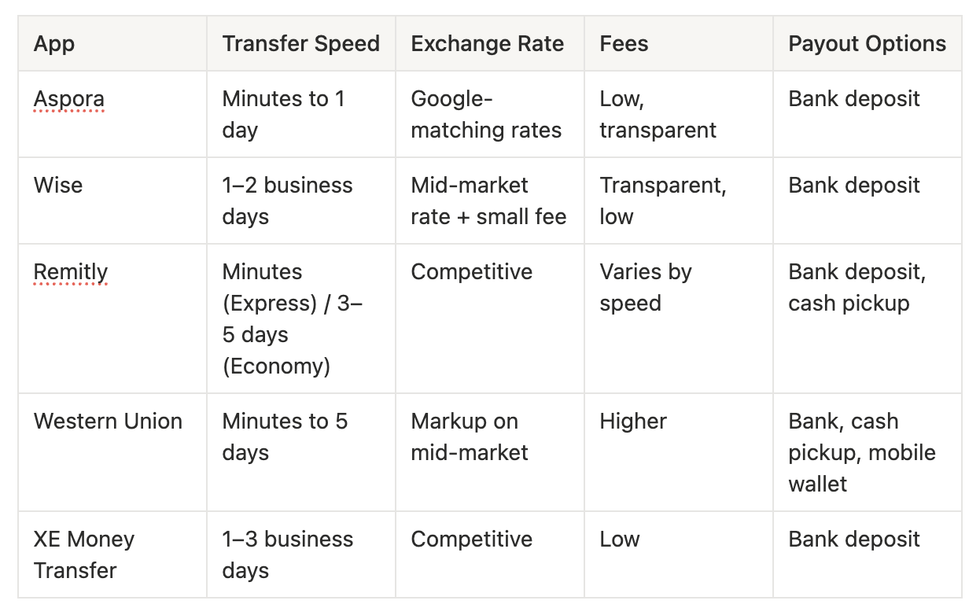
Always run a live comparison on the day you send. Exchange rates move daily, and promotional rates can expire. The only comparison that matters is the actual INR your recipient receives, on the day of transfer. Here is where you can compare all competitors across the board: https://www.aspora.com/us
Are There Reliable Same-Day Transfer Apps from US to India?
Yes — several apps offer same-day or near-instant delivery from the US to India, provided you fund the transfer with a debit or credit card rather than a bank ACH transfer. ACH payments are cheaper but typically take 1–3 business days to clear on the US side, which delays the overall transfer.
For same-day delivery, look for apps that support:
- Card-funded transfers — debit or credit card payments process faster than ACH
- UPI payouts — once funds clear, UPI deposits reach recipients in India within minutes
- Express or instant tiers — some apps offer guaranteed same-day or next-day delivery for a slightly higher fee
One thing to note: even "instant" apps are subject to compliance checks, particularly for first-time senders or large amounts. Building a transfer history with your chosen app helps ensure future transfers move without delays. Aspora supports direct-to-bank and UPI payouts, ensuring funds reach family or service providers seamlessly.
How to Find a Reliable App with Low Fees for US to India Transfers
The lowest-fee app isn't always the cheapest option — and that distinction matters. Some apps advertise zero transfer fees but recover their margin through the exchange rate, offering rates that fall 2–4% below the mid-market. On a $1,000 transfer, that gap can easily cost more than a flat fee would.
To find a genuinely low-cost app:
- Check the total cost — enter your transfer amount and compare the INR your recipient receives, not just the headline fee
- Use ACH funding — bank transfers almost always carry lower fees than card payments
- Watch for promotional rates — first-transfer discounts are common; always check what the standard rate is after the first transfer
- Avoid weekend premiums — some providers widen their margins over weekends when interbank markets are closed
Aspora is built specifically for NRIs and the Indian diaspora in the US. You can monitor real rates and set up transfers at near-interbank value, with no hidden exchange rate markup. The rate you see is the rate your recipient gets.
What Makes a Money Transfer App Secure and Reliable?
A secure and reliable money transfer app is one that is licensed, regulated, and compliant with financial laws in both the sending and receiving countries. In the United States, legitimate money transfer operators are registered with FinCEN — the Financial Crimes Enforcement Network, a bureau of the US Department of the Treasury. On the India side, received funds are deposited in banks governed by the Reserve Bank of India (RBI) and the Foreign Exchange Management Act (FEMA, 1999).
When assessing an app's security, check for:
- US-regulated entities — all legitimate US money transfer operators must be registered
- KYC verification — the app should require identity verification before transfers are processed
- Encrypted data handling — look for SSL/TLS encryption and secure payment processing
- FEMA compliance — transfers must be correctly categorised (family maintenance, education, gifts) to meet Indian regulatory requirements
Large transfers above $10,000 may trigger Currency Transaction Reports (CTRs) under the US Bank Secrecy Act. This is standard compliance procedure — not a red flag. Keeping clear documentation of your transfer purpose is good practice regardless of the amount. Aspora's verification framework ensures alignment with FinCEN requirements, UK FCA standards, and RBI norms — security-first, always.
Setting Up Your Account and Sending Your First Transfer
Getting started on most transfer apps takes under ten minutes. Here's the standard process:
- Sign up and provide your name, address, and date of birth
- Complete KYC — upload a government-issued photo ID (passport or driver's licence)
- Add your recipient — their bank account number and IFSC code, or their UPI ID
- Choose your funding method — ACH bank transfer (lower fee, 1–3 days) or debit card (higher fee, faster delivery)
- Review the INR amount before confirming — check the exchange rate and total fee one final time
- Confirm and track — most apps send SMS or email confirmations, with live tracking until delivery
Keep a record of every transfer — including the reference number, amount sent, exchange rate, and date. This is useful for personal bookkeeping and for compliance purposes if you're ever asked to document large transfers. With Aspora, you can track the process end-to-end and receive instant confirmations.
Tips for Optimizing Cost, Speed, and Convenience
Small habits lead to big savings on international transfers. Here's how to stay ahead:
- Set up rate alerts to send money when INR rates are strongest
- Automate recurring payments for consistent family or tuition support
- Compare providers by total landed cost, not just visible fees
- Use digital-first, regulated apps that settle near mid-market rates
- Avoid last-minute transfers that can trigger premium pricing
Common mistakes include ignoring KYC timelines, skipping compliance declarations, or assuming all 'free' transfers cost the same. Choosing a regulated and transparent partner like Aspora ensures speed, compliance, and safety every time. Try it out now: https://www.aspora.com/us
Your Money Transfer Questions, Answered
2. Are there reliable same-day transfer apps from US to India?
Yes. Apps that support card-funded transfers and UPI payouts can deliver money to India the same day. Transfer speed depends on your funding method — ACH takes 1–3 days, while debit or credit card payments process faster. Always check the app's guaranteed delivery timeframe before sending.
3. How do I compare leading apps to send money from the US to India?
Compare apps by the total INR your recipient receives after all fees and exchange rate margins — not by the advertised fee alone. Enter the same amount in multiple apps on the same day and compare the final payout. A full comparison of popular options is included in this guide.
4. What is the most secure and reliable app to send money from the US to India?
Look for apps registered with FinCEN, licensed as money transmitters in their operating states, and compliant with RBI and FEMA guidelines on the India side. Aspora operates within this regulatory framework, with full KYC verification and encrypted transfer handling.
5. How can I find a reliable app to send money from the US to India with low fees?
Use ACH bank funding rather than card payments, compare total landed cost (not just the fee line), and check whether promotional rates apply only to your first transfer. The cheapest option is almost always the one with the best exchange rate, not necessarily the lowest headline fee.
6. Which apps offer the best exchange rates for US to India transfers?
Apps that use or closely follow the mid-market (interbank) rate offer the best exchange rates. Aspora offers Google-matching rates — the rate you see on Google is the rate applied to your transfer. Avoid apps that advertise 'no fee' but quote rates significantly below the Google rate.
7. What documents do I need to send money from the US to India?
You'll typically need a valid government-issued photo ID (passport or driver's licence), your recipient's bank account number and IFSC code or UPI ID, and for large transfers, documentation explaining the purpose of the transfer (education, family maintenance, gift, etc.).
8. Are there transfer limits for sending money from the US to India?
Yes. App-specific limits vary — many allow up to $25,000–$50,000 per transaction or per day. Indian regulations under FEMA govern how funds are received and classified. Transfers above $10,000 trigger US reporting requirements under the Bank Secrecy Act. Always confirm limits with your chosen app before initiating a large transfer.
9. How long does it take to send money from the US to India?
Transfer times range from minutes (card-funded, UPI payout) to 3–5 business days (ACH-funded, standard bank deposit). The funding method you choose has the biggest impact on speed. Most digital apps are significantly faster than traditional bank wires, which can take 5–7 business days.
10. Is it safe to send large amounts from the US to India through an app?
Yes, provided the app is licensed and compliant. For large transfers, ensure the app is registered with FinCEN, licensed in your state, and that you've documented the transfer purpose. Keeping clear records is standard practice for any international transfer.
11. What is the cheapest way to send money from the US to India?
ACH-funded transfers through a digital app with near-mid-market exchange rates tend to be the most cost-effective. Avoid traditional bank wires, which typically charge flat fees of $25–$50 plus a significant exchange rate margin. Always compare by total INR received, not by the fee line alone.
12. Do I need to report money sent from the US to India for tax purposes?
Large transfers may require reporting under US tax rules. Gifts above the IRS annual exclusion threshold per recipient may require filing Form 709. For transfers related to education, family maintenance, or property, consult a qualified tax adviser or CA to confirm your specific obligations.
References
Download the app
We write to inform, not advise. The content in this article is for general awareness only and does not constitute financial, tax, or legal advice. Tax laws and financial regulations vary across jurisdictions and individual circumstances — what applies in one country may not apply in another. We assume no responsibility or liability for any decisions made based on the information provided here. Always consult a qualified professional before making any financial decisions.